

Cervical Spondylosis Treatment
Age-related neck arthritis, evaluated and treated at five clinics across North Georgia & East Tennessee.
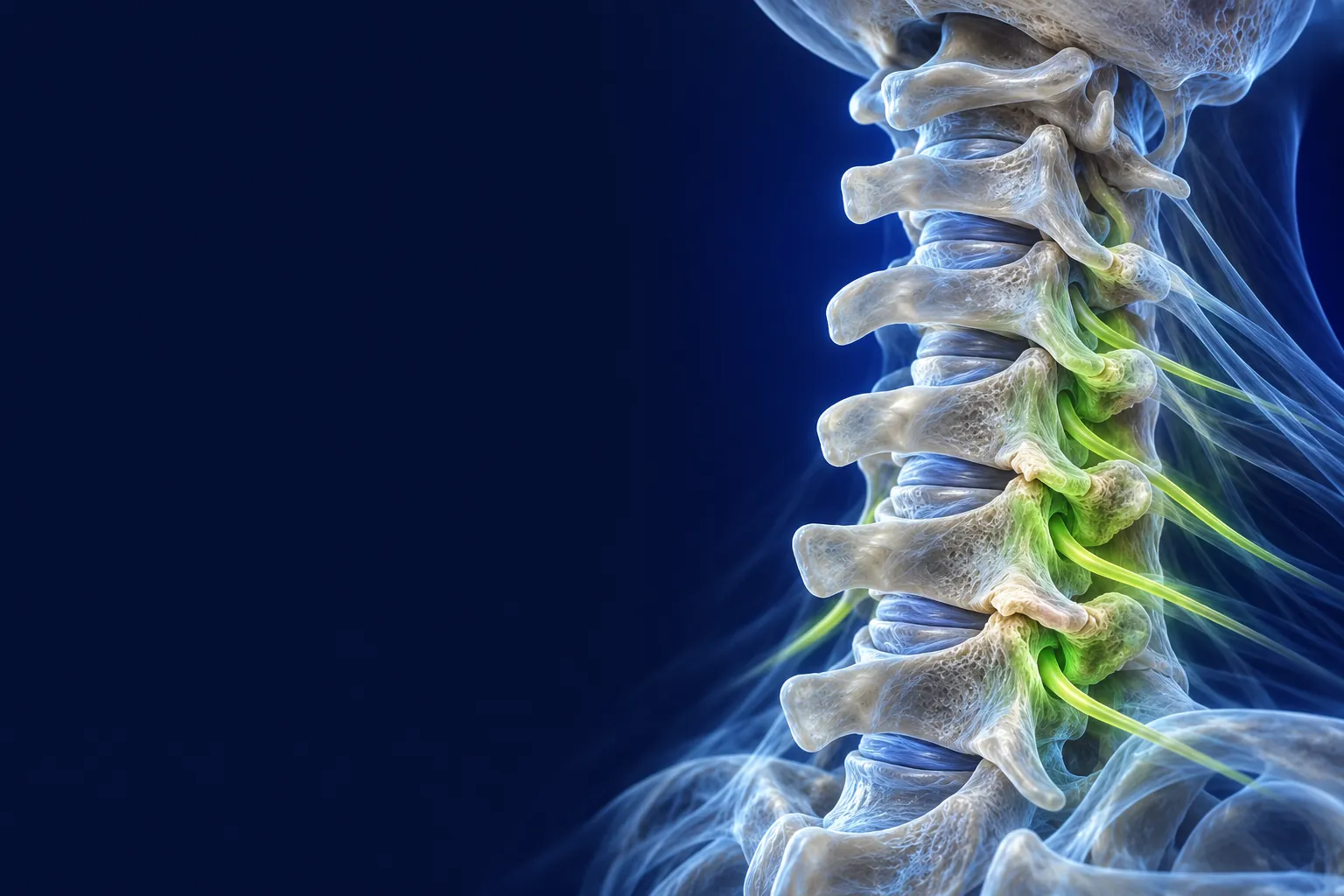
Conceptual illustration
Medically reviewed by Joshua L. Hare, DO, Founder & Medical Director
The neck's version of arthritis
Cervical spondylosis is the medical name for age-related wear in the neck — degenerative change across the discs and small joints of the cervical spine.[1] It is the most prevalent degenerative condition of the cervical spine,[1] appearing in most people after their fifties,[1] and much of the time it causes no symptoms at all. When it does cause trouble, it takes one of three forms: neck pain and stiffness, nerve-root pain running into the arm (radiculopathy), or — least common and most serious — pressure on the spinal cord itself (myelopathy).[1] At IPC, treatment is matched to the form: facet-joint procedures for neck-dominant pain, epidural injections for arm-dominant pain, and prompt referral when the spinal cord is involved.
Talk with our team
Request a callback
The team calls you back within one business day, Monday to Thursday.
Insurance we acceptSymptoms of cervical spondylosis
Which symptoms appear depends on which structures the wear is pressing on:
- Neck pain and stiffness, typically most severe when upright and relieved by lying down
- Pain, tingling or numbness running into the shoulder, arm or hand when a nerve root is compressed
- Hand weakness or clumsiness — trouble buttoning a shirt, tying shoelaces, or picking up small objects — when the spinal cord is involved
- Unsteadiness on your feet or unexplained falls, the other spinal-cord sign
- Often, nothing at all — in many people the wear shows on imaging without ever causing a symptom
Neck-dominant pain, arm-dominant pain and spinal-cord signs each get a different work-up and a different treatment.
When to see a pain specialist about cervical spondylosis
Neck pain that has settled in for weeks despite rest and over-the-counter medication belongs in front of a pain specialist, particularly when it radiates into an arm. Facet-joint pain and nerve-root pain produce similar symptoms and call for different treatments — separating the two is what the evaluation is for.
Hand clumsiness, unsteadiness when walking, new bowel or bladder problems, or rapidly worsening weakness are signs the spinal cord may be involved — any of these needs urgent medical evaluation, not a routine appointment.
Treatment options for cervical spondylosis
Conservative care leads — the reference literature's mainstay is a 4-to-6-week course of physical therapy[1] strengthening the neck and upper back. When neck-dominant pain persists past that, the pain generator is often the facet joints, and the interventional options named for this condition are epidural steroid injections, facet joint injections, medial branch blocks, and radiofrequency lesioning.[1] A 2015 systematic review cited there observed long-term pain relief with cervical radiofrequency lesioning, medial branch blocks, and facet joint injections.[1] Arm-dominant pain from a compressed nerve root points to the epidural route instead.
Cervical Facet Joint Injection
A cervical facet joint injection targets the small joints along the back of the cervical spine that can become...
Cervical Radiofrequency Ablation
Cervical radiofrequency ablation (RFA) uses heat from radio waves to interrupt the medial branch nerves that carry...
Cervical Epidural Steroid Injection
A cervical epidural steroid injection delivers anti-inflammatory medication into the epidural space of the neck to treat...
References
Clinical sources for this page.
Five clinics
Cervical spondylosis treatment in North Georgia and East Tennessee
Pain management specialists accepting new patients at five clinics.