

Joint Injections
Bursa Injection
A bursa injection delivers corticosteroid and local anesthetic directly into an inflamed bursa — a fluid-filled sac that cushions bones, tendons, and muscles near joints — to rapidly reduce inflammation and pain.
Conceptual illustration
Medically reviewed by Joshua L. Hare, DO, Founder & Medical Director
Updated August 2026
Conditions Treated
Trochanteric bursitis (hip),[1] subacromial bursitis (shoulder), prepatellar bursitis (knee), olecranon bursitis (elbow), pes anserine bursitis (knee)
The key facts
Bursa Injection at a Glance
| What it is | Corticosteroid and local anesthetic placed into an inflamed bursa, the fluid-filled cushion that lets tendon slide over bone |
|---|---|
| Most common site | The hip. Lateral hip pain that worsens climbing stairs, rising from a chair, or lying on that side[1] |
| Time in the room | 10–15 minutes |
| Blood thinners | Usually no interruption — bleeding risk is low and anticoagulants can generally be continued unchanged[1] |
| Relief | Anesthetic works in the room; the steroid builds over the following days |
| After | Home the same day; go easy on the area for a day or two |
Talk with our team
Request a callback
The team calls you back within one business day, Monday to Thursday.
Insurance we acceptLateral Hip Pain Is Rarely Just One Thing
The hip is where most of these injections happen, and the modern name for the problem is broader than "bursitis". Greater trochanteric pain syndrome covers several causes of pain over the outer hip, buttock and thigh: bursitis itself, tendinopathy or tearing of the gluteus medius and gluteus minimus, and a snapping iliotibial band — and one patient can have both bursitis and tendinopathy at once.[1]
That matters for what you should expect from us. The injection treats an inflamed bursa directly. Working out which parts are in play is the reason the examination happens before the needle does.
Pain sits over the bony point of the hip and is worst going upstairs, standing up from a chair, or rolling onto it in bed,[1] and tenderness when that bony point is pressed is the finding that separates it from problems inside the hip joint, which usually send pain into the groin instead.[1] It shows up most in women, people carrying extra weight, and adults between 40 and 60.[1]
What the Bursa Is Doing There
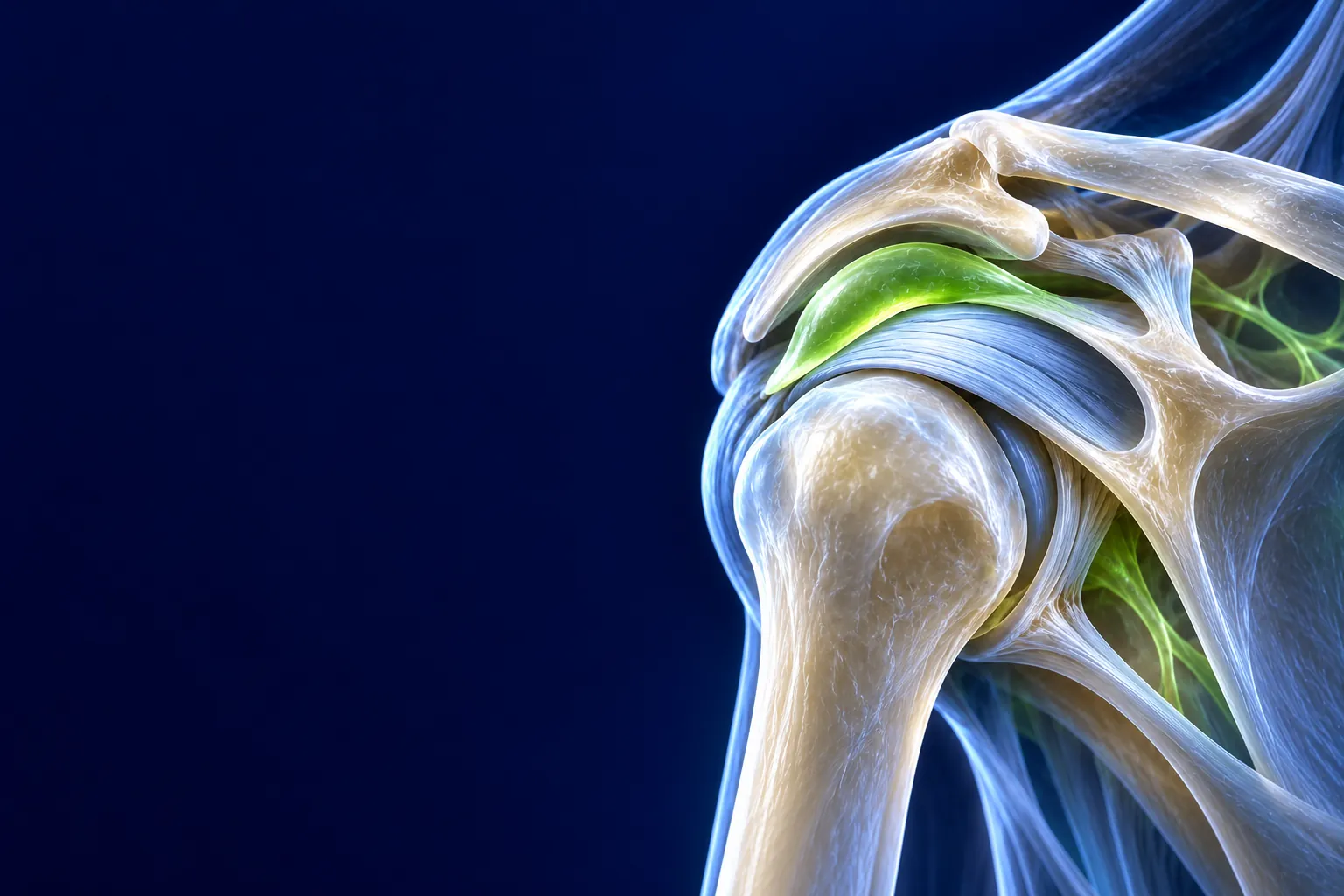
The greater trochanter is the bony prominence at the neck of the femur and the anchor point for the tendons that lift the leg out to the side[1] — tensor fasciae latae, gluteus medius and gluteus minimus.[1] The iliotibial band runs over the outside of it as a thickened strap of the fascia lata, reducing strain across the bone.[1]
A bursa sits between that hard bony corner and the soft tissue sliding across it. Every step you take, the tendon and the band move over the bone, and the bursa is what stops them grinding. Irritate that interface often enough and the cushion inflames, which is why walking and stairs set the pain off.
Candidates
When an Injection Is the Right Move
Injection is a treatment option once the diagnosis is made, and it is considered for patients who have not improved with conservative care.[1] The reference literature is explicit that treatment should not be put off, given how disabling the syndrome is[1] — a hip that stops you sleeping on your own side is a reason to be seen now.
Treatment day
The Injection, Step by Step
- You are positioned face up, the hip resting in neutral.[1]
- The bony point of the greater trochanter is found by feel[1] and that spot is marked.
- Lidocaine numbs the skin and the layer underneath.
- A fine spinal needle is advanced to the outer margin of the bone,[1] then drawn back slightly so the medication lands in the bursa rather than the tendon.
- Long-acting anesthetic and steroid go in together.
Where the bony landmark is hard to feel, imaging is used. Ultrasound shows the tendons and the bursa, the needle tip, and the spread of the injectate, and improves the accuracy of placement compared with landmarks alone;[1] fluoroscopy is the option where the trochanter is difficult to palpate, and it lowers the risk of injecting into the tendon itself.[1] Guidance is also the sensible next step for anyone whose landmark-based injection did not give relief.[1]
Safety
Risks and Side Effects
Injecting this bursa is considered safe and serious problems are uncommon.[1] The ones to know about are pain, bleeding, infection, allergic reaction, and injury to something adjacent;[1] the risk of septic arthritis is under 0.3%.[1] Steroid itself can cause headache, flushing, trouble sleeping, and a rise in blood sugar[1] for a few days, which matters if you are diabetic.
Repeated corticosteroid injection over the long term can weaken tendon and raise the risk of tendon rupture,[1] which is why we space these out and treat the mechanics underneath rather than injecting on a schedule. And a steroid flare — severe local pain arriving 1 to 3 days afterwards and settling within about 5 days[1] — can look alarmingly like an infection. It does not affect how well the injection ends up working,[1] but call us if pain after an injection comes with fever, chills, redness or discharge, because those are the signs that point to infection instead.[1]
Your questions
Common Questions
- Do I need to stop my blood thinner?
- Usually not. Bleeding risk with this injection is low, anticoagulants can generally continue unchanged, and clotting tests are not routinely required.[1] Tell us what you take, because a recent reading well above your target range is a reason to move the appointment rather than proceed.
- Why did the pain get worse two days later?
- That is most likely a steroid flare, and it is self-limited. It arrives a day or three afterwards, settles within about five days, and does not spoil the result. Fever, chills or redness at the site is a different matter and needs a phone call.
- Can I just keep having these?
- Not indefinitely. Repeated steroid over years can weaken the tendons around the hip, so the aim is to use the injection to get you moving, then work on what is loading the hip.
- Why is my hip pain on the outside and not in the groin?
- Pain over the bony point on the side of the hip points at the bursa and the tendons; pain that runs into the groin more often comes from inside the hip joint itself.
- What if it makes no difference at all?
- That is useful information. It suggests the pain is coming from a tendon or the iliotibial band instead of the bursa, or that the medication did not reach the bursa — and the next injection would be done under imaging.
References
Five clinics
Book a visit
Our fellowship-trained physicians are accepting new patients at five clinics: Dalton, Ringgold, Cleveland, Farragut and Oak Ridge.