

Nerve Blocks
Lumbar Sympathetic Block
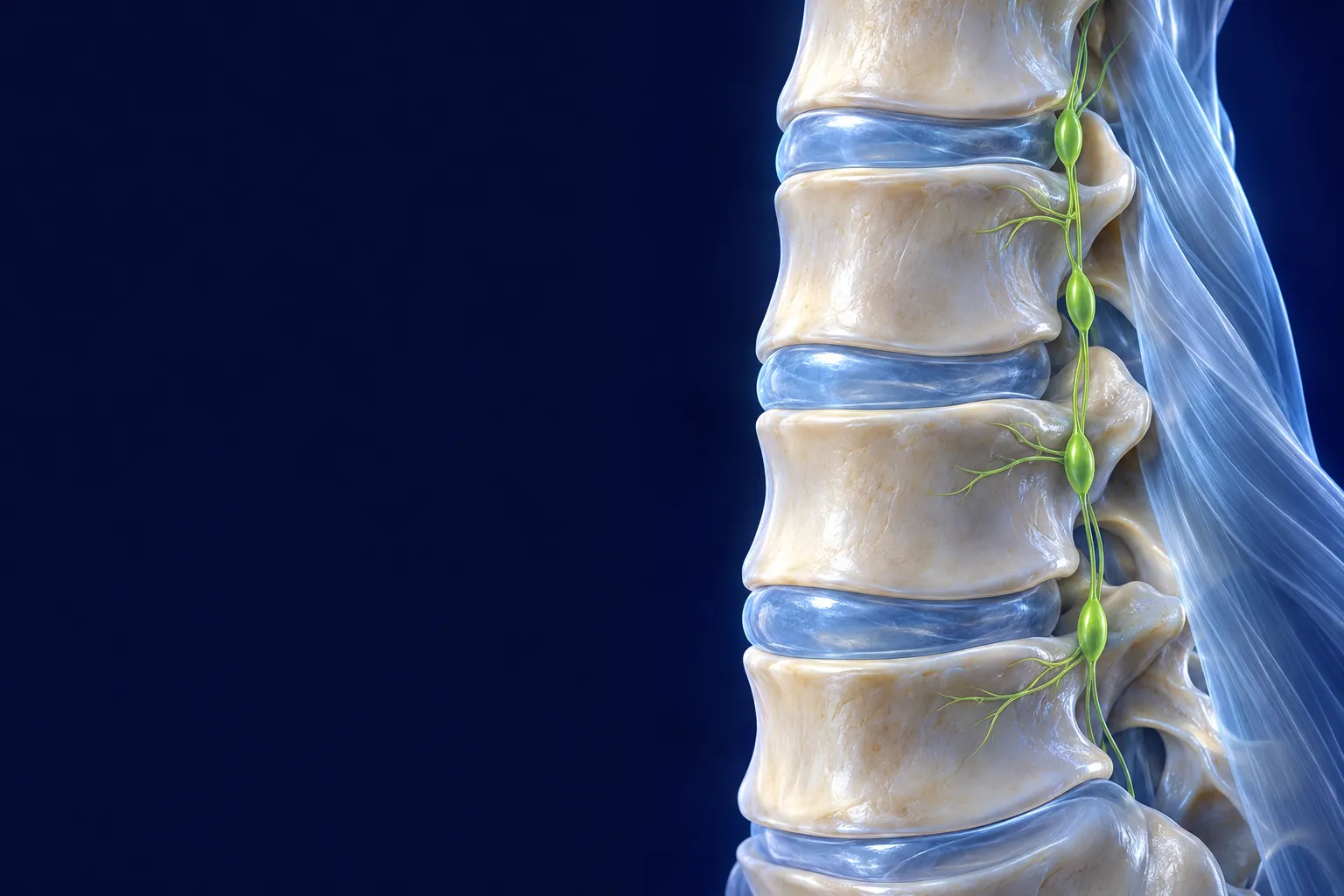
A lumbar sympathetic block involves injecting local anesthetic near the sympathetic nerve chain along the lumbar spine to treat pain conditions of the lower extremities involving the sympathetic nervous system.
Conceptual illustration
Medically reviewed by Joshua L. Hare, DO, Founder & Medical Director
Updated August 2026
Conditions Treated
Complex regional pain syndrome (CRPS) of the lower extremity, sympathetically maintained pain in the legs, peripheral vascular disease pain, phantom limb pain of the lower extremity
The key facts
Lumbar Sympathetic Block at a Glance
| Purpose | Both at once — diagnostic insight and therapeutic benefit[1] from the same needle |
|---|---|
| Target | The lumbar sympathetic chain, most consistently located at the L2 to L3 levels,[1] in front of the spine and behind the abdominal organs |
| Guidance | Fluoroscopy with contrast — the ganglia's position varies from person to person, which is why image guidance is required[1] |
| What is injected | Local anesthetic for diagnostic or therapeutic blocks;[1] longer-lasting options exist for selected cases |
| Time in the room | About 20-30 minutes |
| Proof it worked | The treated leg warms by roughly 2 to 3 °C[1] — measured before you leave |
| Afterwards | A driver takes you home; normal activities typically resume within 24 hours |
Talk with our team
Request a callback
The team calls you back within one business day, Monday to Thursday.
Insurance we acceptDiagnosis and Treatment in the Same Injection
Some leg pain is driven not by the nerves that carry sensation but by the sympathetic nerves that control blood flow, temperature, and sweating. When that system misfires, the leg can burn, discolor, swell, or go cold — the pattern typical of complex regional pain syndrome and related sympathetically maintained pain. Those signals travel through the lumbar sympathetic chain, and numbing it does two jobs in one visit: it helps distinguish sympathetically maintained pain from sympathetically independent pain,[1] and where the sympathetic system is the driver, it reduces the pain, improves regional blood flow, and facilitates functional recovery.[1]
The result matters beyond the day of the block: a favorable response guides treatment — repeat blocks, neuromodulation, or chemical neurolysis.[1]
In CRPS, Timing Is Part of the Treatment
The strongest indication is lower-limb complex regional pain syndrome, particularly early in the disease course:[1] response is significantly better when symptoms have lasted less than 12 months,[1] and earlier intervention is associated with improved analgesic outcomes and greater participation in physical therapy.[1] If CRPS is suspected in your leg or foot, that twelve-month window is a reason to be evaluated now.
Beyond CRPS: Other Conditions It Can Help
Because the sympathetic chain also governs circulation, this block can help conditions that structural spine procedures do not address. In ischemic lower-limb pain where revascularization is not an option, sympathetic blockade can improve pain, limb temperature, and walking distance.[1] In painful diabetic neuropathy, the block and subsequent neurolysis have produced sustained pain relief and improved microcirculation,[1] and refractory lower-limb neuropathic pain may improve after repeated blocks even when other interventions have failed.[1] The clinical reference behind this page also lists lower-limb postherpetic neuralgia, vasospastic disorders such as Raynaud's phenomenon, Buerger disease, residual limb and phantom limb pain in selected patients, and cancer-related pain of the pelvis and lower extremities[1] among its indications.
Treatment day
The Block, Step by Step
- You lie face down with monitors on and an IV placed; the lower back is cleaned and draped.
- The fluoroscope is angled to line up the L2 and L3 vertebrae, and the skin entry point is numbed.
- A thin needle is guided to the front edge of the vertebral body, kept in contact with the bone to stay clear of the great vessels that run just in front of it.[1]
- A side view confirms the depth, and contrast dye is injected to verify the spread outlines the front of the spine from L1 to L3.[1]
- The anesthetic is injected and the needle is withdrawn.
- Your leg temperature is checked to confirm the block worked, and after observation your driver takes you home.
You Learn Whether It Worked Before You Leave
With most pain procedures you wait days to find out whether it helped. Here the check happens before you leave: the most reliable indicator of a successful block is a rise of about 2 to 3 °C in the temperature of the treated leg,[1] often felt as a pleasant flush of warmth spreading down the limb. That objective sign tells your physician the sympathetic chain was reached — so whatever your pain does next is informative, whether that is hours of relief from a diagnostic block or the start of a cumulative therapeutic series.
Safety
Risks and Side Effects
Placed under image guidance, this is generally a safe procedure, with most adverse events uncommon and transient.[1] The one to know about is the most ordinary: temporary low blood pressure, a direct result of the same vasodilation that warms the leg[1] — you are monitored until it passes. Less common possibilities include temporary groin or thigh numbness if the injectate reaches the genitofemoral nerve,[1] bruising or bleeding near the injection path, and — rarely — vascular injury or systemic effects of the anesthetic, which careful aspiration and contrast confirmation are specifically designed to prevent.[1] Infection is rare under sterile technique.
Your questions
Common Questions
- Why did my leg get warm afterwards?
- Because the block worked. The sympathetic nerves keep blood vessels slightly clenched; numbing them lets the vessels relax and blood flow rise, which you feel as warmth. It is the same mechanism that relieves sympathetically driven pain.
- How long will the relief last?
- It depends on the job the block is doing. A diagnostic block is expected to wear off with the anesthetic; its value is what it tells us about the source of your pain. Therapeutic blocks are often given as a series that can build on one another, and for the right candidates longer-lasting options such as neurolysis exist as a next step.
- Is this the same as an epidural?
- No. An epidural treats the nerve roots inside the spinal canal. This block targets a chain of autonomic ganglia that sits in front of the spine and never enters the canal at all.
- I was told to come in soon. Why the urgency?
- For CRPS specifically, the published evidence favors treating within the first year of symptoms: response rates are significantly better and early treatment supports the physical therapy that drives recovery.
References
Clinical sources for this page.
Five clinics
Book a visit
Our fellowship-trained physicians are accepting new patients at five clinics: Dalton, Ringgold, Cleveland, Farragut and Oak Ridge.