

Sacroiliac Joint Procedures
Sacroiliac Joint Injection
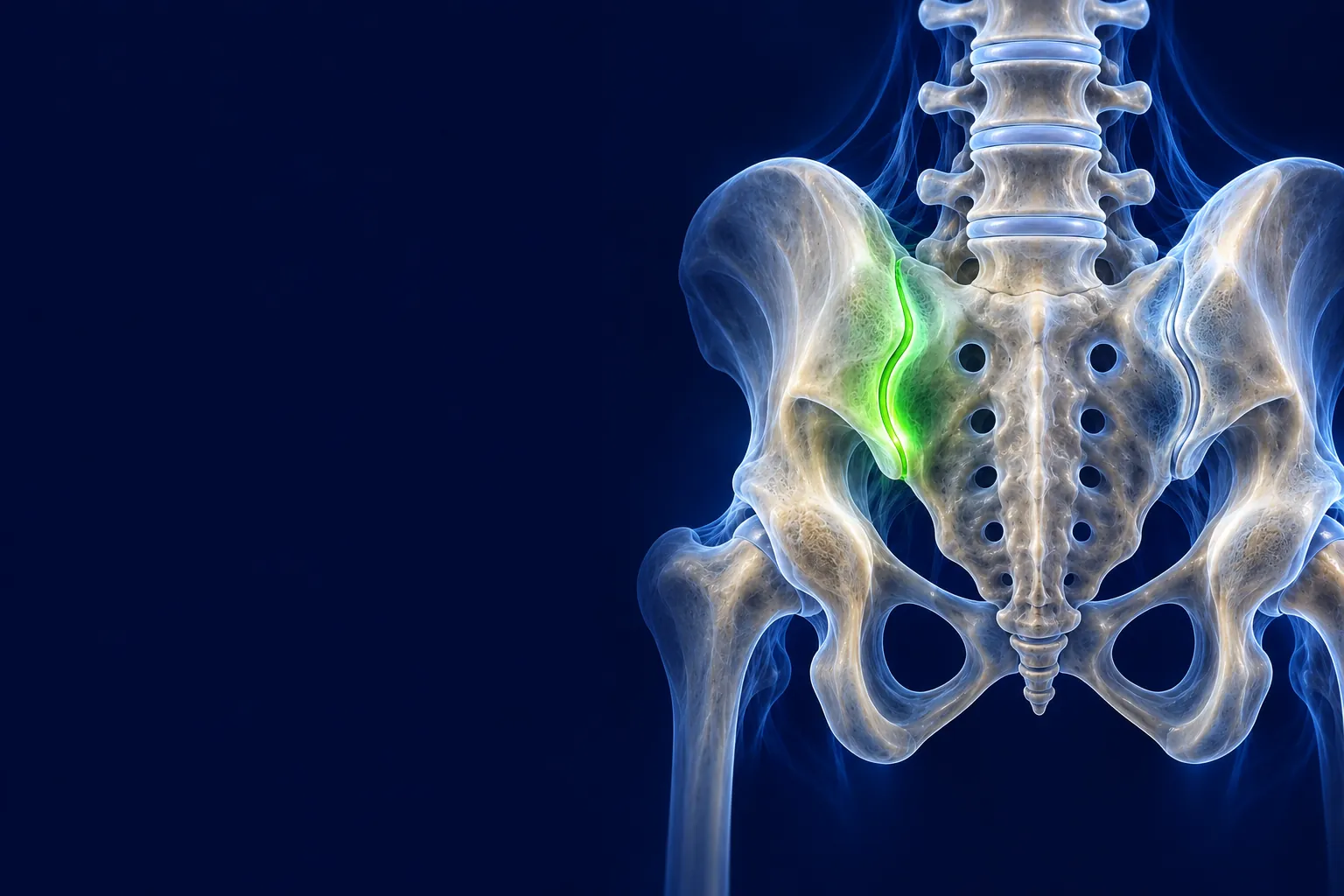
A sacroiliac (SI) joint injection delivers anesthetic and corticosteroid directly into the SI joint — the large joint connecting the sacrum (base of the spine) to the ilium (pelvis). This injection serves as both a diagnostic test and a therapeutic treatment.
Conceptual illustration
Medically reviewed by Joshua L. Hare, DO, Founder & Medical Director
Updated August 2026
Conditions Treated
Sacroiliitis, SI joint dysfunction, SI joint arthritis, post-pregnancy SI pain, pain after lumbar fusion
The key facts
SI Joint Injection at a Glance
| What it is | Local anesthetic and corticosteroid placed inside the sacroiliac joint under imaging, answering the diagnostic question and treating the joint in one appointment[1] |
|---|---|
| Who it is for | Low back pain sitting below L5 that reproduces on three or more provocative maneuvers[1] with no clearer source found |
| How the joint is found | Fluoroscopy, with contrast confirming the needle is inside the joint before anything else goes in |
| A positive result | At least 75% less pain[1] while the anesthetic is working, measured against the movements that normally hurt |
| Time in the room | 15–20 minutes |
| Needle | 22- to 25-gauge spinal needle,[1] placed into the lower part of the joint |
Talk with our team
Request a callback
The team calls you back within one business day, Monday to Thursday.
Insurance we acceptWhy This Joint Is Hard to Blame
The sacroiliac joints carry a real share of ordinary low back pain: roughly 10% to 27% of mechanical low back pain[1] comes from them. They are also easy to miss, because the pain refers into the buttock, the groin, or down the leg[1] and overlaps with lumbar spine and hip problems.[1] Plenty of people arrive here after imaging of the lumbar spine came back unremarkable, or after a disc was treated and the pain stayed.
The joint gets irritated in recognizable ways: degenerative change, altered pelvic mechanics, trauma, inflammatory arthritis, pregnancy, or previous lumbar spine surgery.[1] That last one matters here, because fusing a segment above changes how load reaches the pelvis, and pain after lumbar fusion is one of the patterns this injection is used to sort out.
What the Joint Actually Does
Each sacroiliac joint connects the sacrum to the ilium and is wrapped in a heavy ligament complex.[1] Its job is pelvic stability and the transfer of load between the legs and the spine,[1] and it does that job with very little movement — about 2 to 4 degrees of rotation and 1 to 2 millimeters of translation.[1] A joint that barely moves can still hurt a great deal, which is part of why patients are told for years that nothing is wrong.
Sensation is carried mainly by the lateral branches of the dorsal rami from L5 through S4, and that supply varies from person to person.[1] That is why two people with the same joint problem describe pain in different places. It is also why lateral branch radiofrequency ablation is the treatment that follows when the joint is confirmed and the relief keeps wearing off.
Why Image Guidance Is Not Optional Here
Injection by feel alone lands inside the joint in only 12% to 22% of attempts.[1] An injection that never entered the joint tells you nothing about whether the joint is the problem, and a negative result from one can send a patient down years of the wrong treatment.
So the needle is placed under fluoroscopy and contrast is injected first, outlining the joint and showing no vascular uptake,[1] before any medication follows.
Treatment day
The Injection, Step by Step
- You settle onto the table on your front. A cushion sits under your lower abdomen, level with the top of the pelvis, to take the arch out of your low back.[1]
- The C-arm is angled until the bony margins of the lower joint space line up parallel,[1] which is the view that makes the target clear.
- The skin is cleaned, draped, and numbed.
- A spinal needle is advanced into the lower part of the joint. Entry is often felt as a subtle give or a small pop.[1]
- A third to half a milliliter of contrast[1] confirms the needle is inside the joint.
- Anesthetic and corticosteroid are injected, stopped at a firm endpoint or at a total of about 2.5 milliliters.[1]
The Next Few Hours Are the Test
The anesthetic starts working in the room, and that window is the diagnostic part. A block counts as positive when your pain drops by at least 75% while the anesthetic is active, during the activities that normally bring it on.[1] Sitting still afterwards defeats the purpose: go and do the thing that usually hurts, and write down what happened and when.
That is why we ask for a diary rather than an impression at the next visit. The steroid then takes over as the anesthetic fades, with its effect building across the following days.
How Long the Relief Lasts
Systematic reviews support the safety and effectiveness of corticosteroid injection into this joint,[1] and the evidence supports its use in chronic low back pain referring below L5.[1] For patients who respond, the relief can run a long way: in inflammatory sacroiliitis, around two-thirds of patients had relief lasting beyond six weeks, and among responders the average duration approached 37 weeks.[1]
Where relief is real but keeps running out, lateral branch radiofrequency ablation and minimally invasive fusion are the recognized next steps[1] — ablation treats the nerves carrying the signal, and fusion treats the joint itself. Both of those decisions rest on the answer this injection produces, which is why it comes first.
Safety
Risks and Side Effects
Image-guided injection of this joint is generally safe, and most side effects are minor:[1] soreness at the needle site, a short flare of pain before the steroid works, and occasionally a faint or lightheaded episode on the table. Uncommon but more serious problems include nerve irritation or an unintended nerve root block, bleeding into the tissues, infection, injection into a blood vessel, and the systemic effects of steroid.[1]
Tell us about blood thinners, diabetes, and any current infection when the visit is booked. Anticoagulation, poorly controlled diabetes, and active infection all change the calculation,[1] and pregnancy is weighed case by case.
Your questions
Common Questions
- Will one injection tell you what is wrong?
- Usually it tells us a great deal, because the anesthetic window is a direct test of the joint. If your pain falls away while the joint is numb and returns as it wears off, the joint is the source.
- Why do you keep asking me to move around afterwards?
- Because the answer is measured against the activities that normally hurt. Resting through the anesthetic window produces a diary that cannot be read either way.
- How is this different from an epidural or a facet injection?
- Both of those target the spine itself. This needle goes into the joint where the base of your spine meets your pelvis — lower down, and further out toward your hip.
- What if the pain comes back after a few months?
- That is common and it is useful information rather than a failure. A joint that answers to injection and then reverts is the profile that radiofrequency ablation is built for.
- Can I have it if I take a blood thinner?
- Often, but not without planning. Tell the team when you book so the medication and the timing can be worked out in advance.
References
Clinical sources for this page.
Five clinics
Book a visit
Our fellowship-trained physicians are accepting new patients at five clinics: Dalton, Ringgold, Cleveland, Farragut and Oak Ridge.