

Facet Joint Procedures
Lumbar Facet Joint Injection
A lumbar facet joint injection delivers a combination of local anesthetic and corticosteroid directly into one or more facet joints in the lower back to reduce inflammation and provide pain relief.
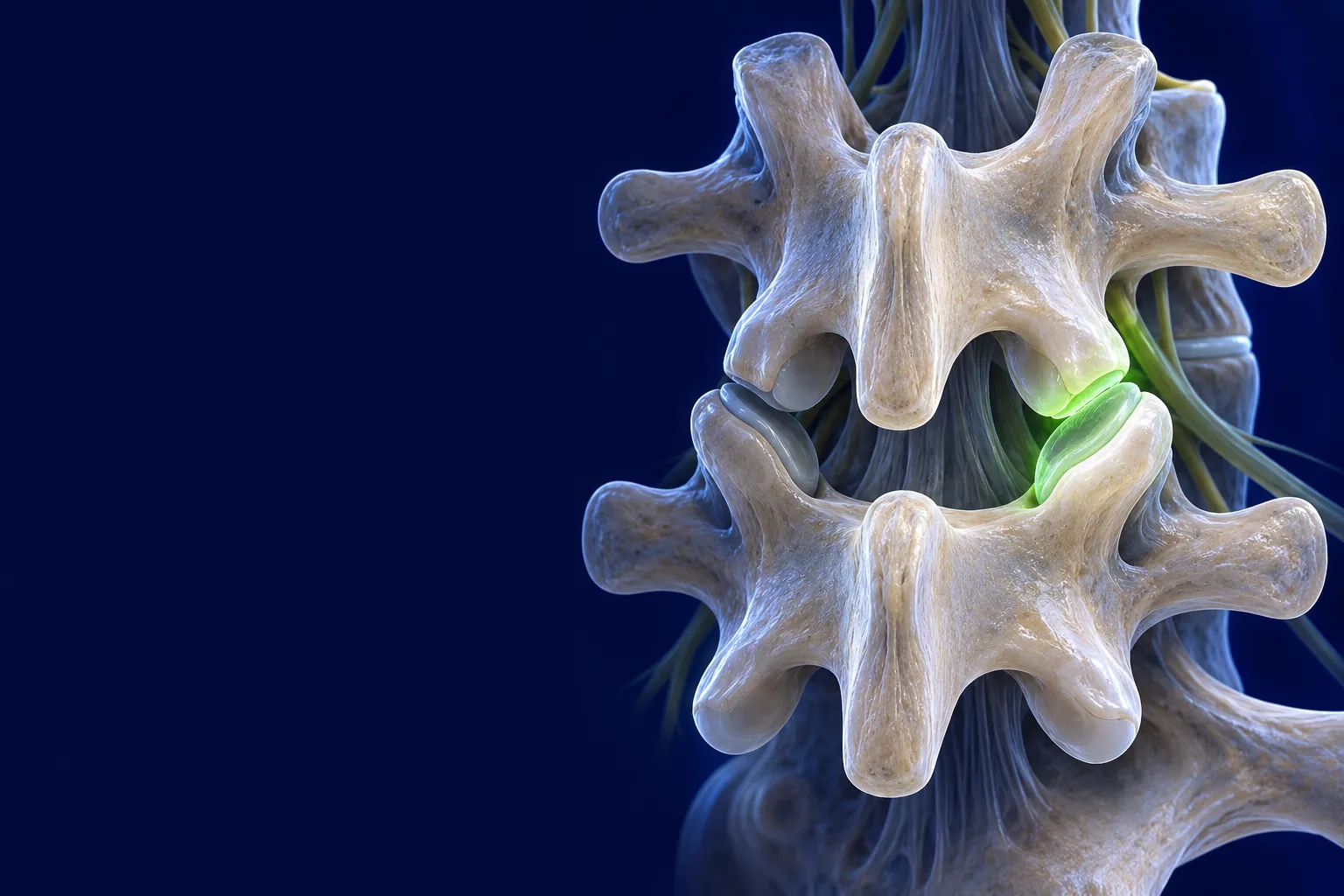
Conceptual illustration
Medically reviewed by Joshua L. Hare, DO, Founder & Medical Director
Updated September 2026
Conditions Treated
Lumbar facet joint arthritis, facet syndrome, spondylosis, mechanical low back pain
| What it is | Local anesthetic and a corticosteroid placed inside a facet joint of the lower back, through a thin needle, under live X-ray. |
|---|---|
| What it answers | Whether that joint is generating your pain. Consensus guidance holds that IA injections may be used for both diagnostic and therapeutic purposes[1] in selected patients. |
| Who it suits | The guideline names two groups in particular: young people with inflammatory pain,[1] and people at raised risk of complications from nerve ablation. |
| Before it is offered | A documented trial of conservative care. Coverage guidance asks for failure of at least 3 months of conservative therapy,[1] counting exercise, physical therapy, chiropractic care or analgesics. |
| Typical visit | Fifteen to thirty minutes as an outpatient. Mild soreness where the needle went in is common for a day or two, and most people are back to their usual routine the next day. |
| Duration of relief | Weeks to months. A good response is also the finding that makes radiofrequency ablation worth discussing for longer cover. |
Talk with our team
Request a callback
The team calls you back within one business day, Monday to Thursday.
Insurance we acceptWhy the Lower Back Is Hard to Diagnose From the Outside
Every level of the lower spine is steadied from behind by a small pair of joints, one on each side, called the facet joints. They wear like any other joint, and when they hurt the pain is usually a deep ache across the lower back that is worse standing, arching backward or twisting.
The difficulty is that nothing on examination proves it. The guideline states the position bluntly: there are no pathognomonic physical examination or historical signs[1] that reliably predict a response to facet joint blocks in mechanical low back pain, though pain that is not predominantly in the midline,[1] and possibly tenderness over the joints themselves, are weakly associated with a positive response. Reported prevalence reflects the same uncertainty, ranging from 5% to 90%[1] depending on whether history, examination or imaging is used to define it.
Scans do not close the gap either. For scintigraphy, MRI and CT the guideline finds weak or no evidence[1] supporting their use to identify painful lumbar facet joints before a block. Imaging still matters for excluding other causes. It is not what tells you the facet joint is the culprit.
So the Joint Is Asked Directly
That is what this injection is for. Anesthetic placed inside the joint numbs it for a few hours. If your familiar pain fades during that window, the joint was carrying it. If nothing changes, it was not, and you have been spared a longer course of treatment aimed at the wrong structure.
The corticosteroid delivered alongside it is the part meant to last, which is why this is not purely a test. Consensus guidance is explicit that IA injections may be used for both diagnostic and therapeutic purposes in some individuals,[1] and it names who: young people with inflammatory pain,[1] and people for whom the risks of radiofrequency ablation are higher than usual. If you are in neither group, the injection may still be the right first step, and your physician will explain what the result would change.
Conservative Care Comes First, and That Is Not Just Paperwork
Interventional treatment sits downstream of the ordinary things. Coverage guidance cited in the guideline asks for failure of at least 3 months of conservative therapy[1] before diagnostic facet blocks or ablation are considered, and defines that to include exercise, physical therapy, chiropractic care and analgesics.[1]
The guideline is candid that the effect sizes for conservative treatment in chronic low back pain are only small,[1] and that the case for trying them first rests on their relatively lower costs and risks[1] rather than on large benefits. It also notes that if primary care has followed its own guidelines, most people reaching a pain specialist have already trialed many conservative treatments.[1] If that describes you, bring the record of what you tried and for how long. It is usually the difference between being scheduled and being sent away to document it.
How the Injection Is Performed
The joint is entered under live X-ray. Image guidance is not a refinement here: the guideline calls it an essential component of performing spinal procedures[1] in pain management, and notes that it improves safety through direct visualization of bony elements[1] so that nearby structures are avoided. Fluoroscopy is the gold standard for facet blocks.[1]
Volume is controlled deliberately and it is a smaller amount than most people expect. Lumbar intraarticular facet injections should be performed with a volume of less than 1.5 mL,[1] specifically to prevent capsular rupture and reduce spread to adjacent structures. A facet joint holds very little, and overfilling it both risks the capsule and blurs the answer, because medication that escapes the joint can numb things outside it and make the test read positive for the wrong reason.
Safety, and the Blood-Thinner Question
Facet joint injections have a good safety record. In a series of 3,162 medial branch procedures, superficial bleeding or bruising occurred in 0.1% to 0.4% of patients.[1]
The part worth reading carefully concerns anticoagulants, because the intuitive answer is the wrong one. Among patients who continued their anticoagulant therapy[1] through the procedure, no bleeding complications were observed. Among 2,296 patients who stopped theirs,[1] nine adverse events were reported. A survey of interventional pain physicians found thromboembolic events were three times more likely than bleeding complications[1] after spine procedures, and that those events were more severe and more common when anticoagulants were discontinued,[1] with no measurable difference in bleeding either way.
The practical consequence: do not stop a blood thinner on your own before this appointment. Tell the practice what you take and let the decision be made deliberately, with whoever prescribed it. Stopping it unasked is the choice this evidence argues against.
What the Result Points To
Relief usually arrives in two stages. The anesthetic works within minutes and fades the same day. The corticosteroid follows across roughly the next week, with the full effect generally settled by two weeks, and the benefit is commonly measured in weeks to months.
What happens next depends on which of those you get. Durable relief may simply be repeated when it fades. Clear but short-lived relief is the more informative result, because it identifies the joint while showing that an injection will not hold it. That is the finding that makes radiofrequency ablation worth discussing, and it is why the guideline treats the block and the ablation as parts of one sequence rather than as competing options.
No useful change at all is also an answer. It moves the search off the facet joints and back to the disc, the sacroiliac joint, the hip or the nerve roots, and it does so before anything irreversible has been done.
Five clinics
Book a visit
Our fellowship-trained physicians are accepting new patients at five clinics: Dalton, Ringgold, Cleveland, Farragut and Oak Ridge.