

Whiplash Treatment After a Car Accident
Neck injury from a collision, a fall or a hard impact at work. Interventional Pain Consultants — five clinics across North Georgia & East Tennessee.
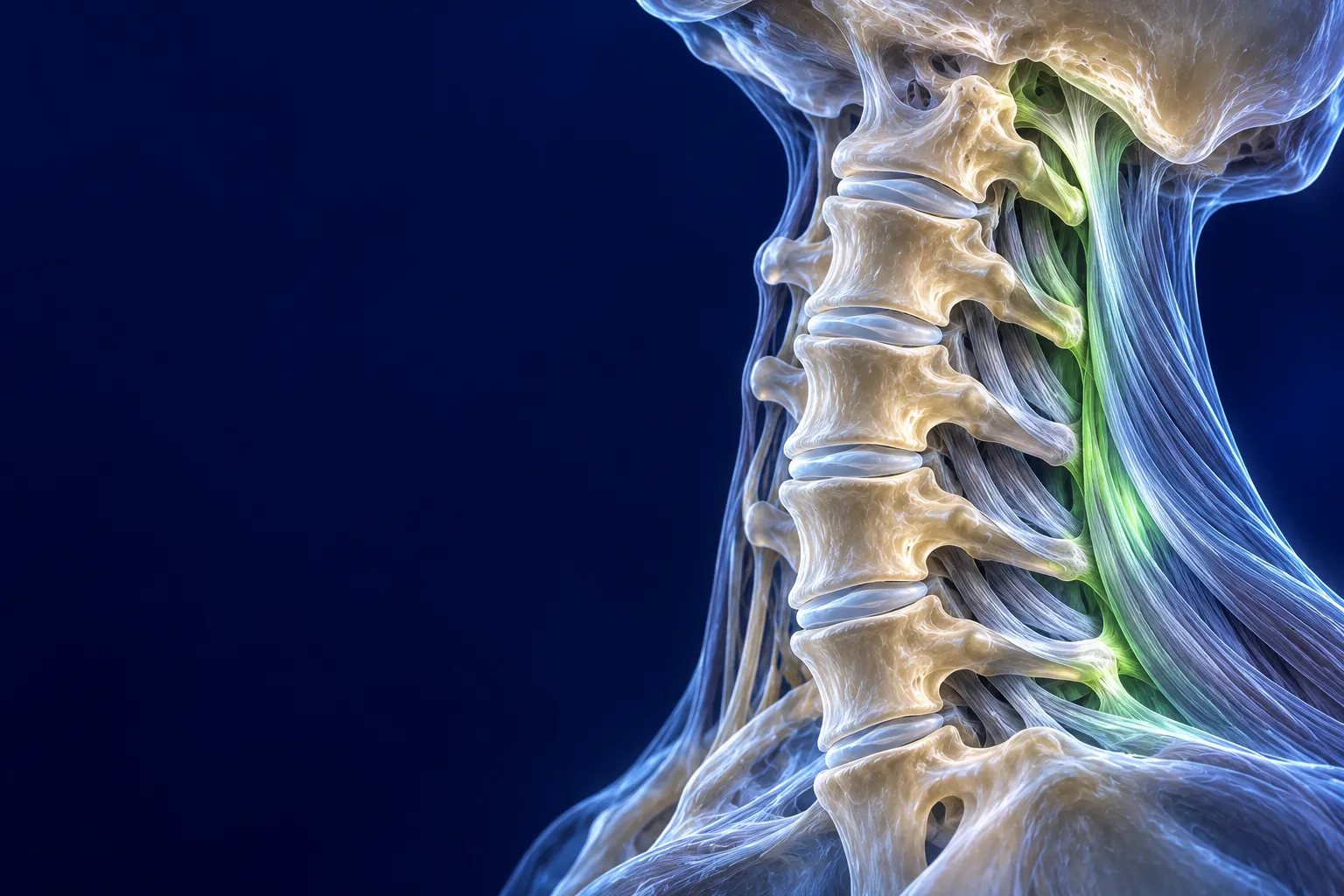
Conceptual illustration
Medically reviewed by Joshua L. Hare, DO, Founder & Medical Director
What happens to the neck in a collision
In a rear-end collision the neck is whipped rapidly back and forth.[1] A hard fall, or any other sudden movement that forces the neck to bend or twist to an extreme position,[1] does the same thing. The muscles and ligaments are strained beyond their normal range of motion,[2] and clinicians call the result whiplash-associated disorder.[3]
Motor vehicle accidents are the mechanism in about 86% of cases,[3] followed by falls and sports injuries. The force impacts the facet joints[3] at the back of the neck.
After a crash, imaging is often normal despite significant symptoms, which makes whiplash-associated disorder a diagnosis of exclusion.[3] Most whiplash injuries are considered to be minor soft-tissue injuries without evidence of fracture,[3] though the Quebec Task Force scale grades severity up to fracture or dislocation.[3] Whiplash is also called neck sprain or strain.[2] Neck pain that did not begin with an injury is covered on the neck pain page.
Talk with our team
Request a callback
The team calls you back within one business day, Monday to Thursday.
Insurance we acceptSymptoms of whiplash
Pain from a neck sprain does not always appear right away; symptoms may not start until hours after the injury, or even the next day.[1] There is often pain and stiffness in the neck for the first few days, and the pain can also be felt in the surrounding muscle groups of the head, chest, shoulders and arms.[2] Neck pain is the symptom patients report most often, and headache is next.[3]
The American Academy of Orthopaedic Surgeons lists these among the symptoms of a neck sprain or strain, whiplash included:
- Muscle spasm across the upper shoulder, and headache at the back of the head[1]
- Dizziness, and pain or stiffness in the jaw[2]
- Numbness in the arm or hand, or tingling and weakness in the arms[1]
- Irritability, fatigue, difficulty sleeping and difficulty concentrating[1]
Because the pain can be delayed, a neck injury is worth an evaluation even if you feel fine.[1]
When to see a pain specialist about whiplash
Most symptoms of a neck sprain or strain go away in 4 to 6 weeks, and severe injuries take longer.[1] Chronic whiplash-associated disorder develops in about a quarter of patients,[3] and roughly half still report some symptom a year after the injury.[3] If the pain is still there past that six-week window, or it is waking you or keeping you off work, have the neck evaluated.
Get immediate medical attention for neck pain that is constant and does not lessen, severe pain that over-the-counter medication does not relieve, pain shooting down the arms and legs, or a headache with numbness, tingling or weakness in the arms and legs.[1]
Once a structural injury has been ruled out, the first step is movement. International guidelines recommend early mobilization and activity over rest and prolonged collar use.[3] When pain outlasts those first six weeks, the cervical facet joints are the first structure to test. Half of the persistent pain after whiplash comes from the cervical facet joints,[3] and dual diagnostic medial branch blocks[4] can identify them.
Treatment options for whiplash
Relief after a cervical medial branch block with local anesthetic is the accepted reference standard for identifying the facet joints as the source,[4] with at least a 50% reduction in pain counted as a positive block.[4] The 2022 international consensus guideline on cervical facet joint pain recommends a six-week trial of conservative management first.[4] When the block relieves that pain, cervical medial branch radiofrequency ablation is the reasonable next step.[3]
Medial Branch Block
A medial branch block is a diagnostic injection that temporarily numbs the small medial branch nerves that transmit...
Cervical Radiofrequency Ablation
Cervical radiofrequency ablation (RFA) uses heat from radio waves to interrupt the medial branch nerves that carry...
The 2022 guideline describes the randomized, placebo-controlled trial that demonstrated the efficacy of cervical radiofrequency ablation for whiplash-induced neck pain:[4] seven of twelve treated patients had at least three months of relief, median 263 days.[4] A systematic review of the fluoroscopically guided procedure in chronic facet joint neck pain found a majority of patients pain free at 6 months and over a third at 1 year,[5] and that, performed to the Spine Intervention Society technique, it carries only minor risks.[5] In the 1996 trial, five of twelve had numbness over the treated nerves, and none considered it troubling.[6]
References
Clinical sources for this page.
- Neck Sprains and Strains. OrthoInfo, American Academy of Orthopaedic Surgeons. Back to first citation ↑
- Whiplash; Location of whiplash pain; Neck Injuries and Disorders. MedlinePlus, National Library of Medicine. MedlinePlus MedlinePlus Back to first citation ↑
- Lehman A, Margetis K. Cervical Sprain. StatPearls [Internet], National Library of Medicine; updated April 12, 2026. Back to first citation ↑
- Hurley RW, et al. Consensus practice guidelines on interventions for cervical spine (facet) joint pain. Regional Anesthesia and Pain Medicine. 2022;47(1). Full text Back to first citation ↑
- Engel A, et al. Fluoroscopically guided cervical medial branch thermal radiofrequency neurotomy: a systematic review. 2016. Back to first citation ↑
- Lord SM, et al. Placebo-controlled trial of radiofrequency neurotomy for chronic cervical zygapophyseal joint pain. New England Journal of Medicine. 1996. Back to first citation ↑
Five clinics
Whiplash care in North Georgia and East Tennessee
Pain management specialists accepting new patients at five clinics.