

Nerve Blocks
Celiac Plexus Block
A celiac plexus block involves injecting local anesthetic (and sometimes a neurolytic agent) near the celiac plexus — a network of nerves located behind the stomach near the aorta — to treat severe abdominal pain, particularly from pancreatic cancer or chronic pancreatitis.
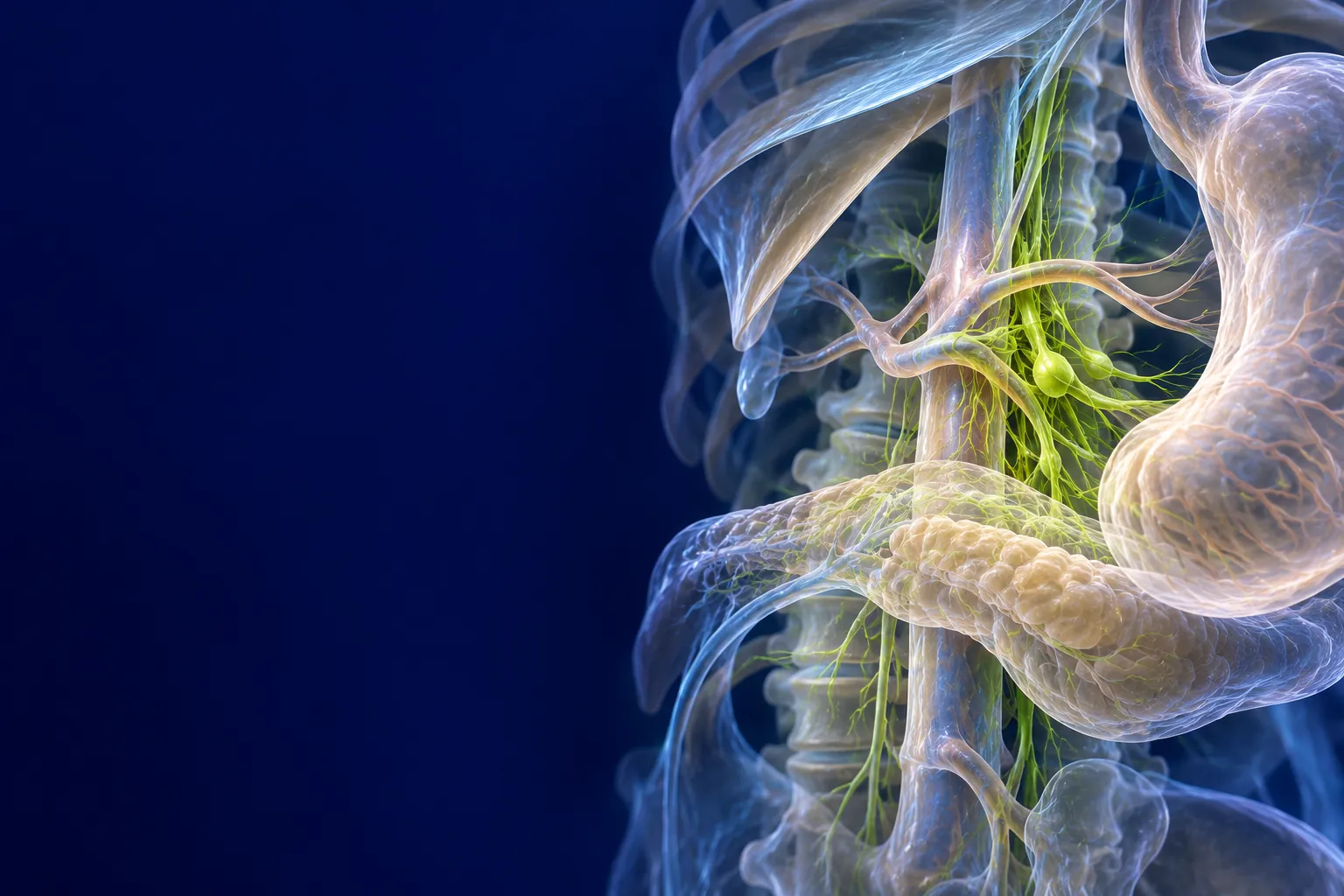
Conceptual illustration
Medically reviewed by Joshua L. Hare, DO, Founder & Medical Director
Updated September 2026
Conditions Treated
Pancreatic cancer pain, chronic pancreatitis pain, other upper abdominal cancer pain
The key facts
Celiac Plexus Block at a Glance
| What it treats | Persistent upper-abdominal pain, most often from pancreatic cancer;[1] also other abdominal cancers and selected non-cancer pain |
|---|---|
| Type of procedure | Outpatient, image-guided (fluoroscopy or CT) |
| Time in the procedure room | About 30–45 minutes |
| Positioning | Usually face down; a face-up approach exists for patients who cannot lie prone[1] |
| Two versions | A temporary local-anesthetic block, and a longer-lasting neurolytic block |
| Expected after-effects | Lightheadedness on standing and looser stools for a day or two — both temporary, both explained below |
Talk with our team
Request a callback
The team calls you back within one business day, Monday to Thursday.
Insurance we acceptThe treatment explained
How It Works
Under fluoroscopic or CT guidance, needles are placed near the celiac plexus.[1] For diagnostic and temporary blocks, local anesthetic is used. For long-lasting neurolysis (typically in cancer patients), alcohol or phenol may be injected to permanently destroy the nerve fibers.
The celiac plexus — sometimes called the solar plexus — is the nerve network that carries pain signals from most of the upper abdomen: the liver, gallbladder, stomach, pancreas, spleen, kidneys and much of the bowel.[1] That is why one carefully placed block can quiet pain from several organs at once: their signals all funnel through this single junction.
Candidates
Who It Helps — and How We Decide
This block is for abdominal pain that has not responded to less aggressive treatment[1] — most often the deep, persistent pain of pancreatic cancer, where medication alone frequently is not enough. For cancer pain, the neurolytic version is the standard path. For non-cancer causes, the temporary local-anesthetic version is used instead, and for chronic pancreatitis specifically the decision is more individual — the clinical literature is still divided[1] on which of those patients benefit most, and your provider will be straight with you about whether your case fits.
A diagnostic step comes first either way: the clinical reference calls starting with a local-anesthetic test block imperative,[1] because relief from the test is what confirms the plexus is actually carrying your pain before anything longer-lasting is done.
Treatment day
The Day of the Procedure
- Positioning. Usually face down with support under the abdomen; patients who cannot lie prone are treated face up through the anterior approach.
- Numbing and placement. After local anesthetic at the skin, thin needles are guided toward the plexus at the T12–L1 level, with the position confirmed by contrast dye on imaging before any medication is injected.
- The block. Local anesthetic for a test or temporary block; a neurolytic agent for the long-lasting version. The whole visit in the procedure room runs about 30–45 minutes.
- Recovery room. Observation with attention to blood pressure — lightheadedness on standing is the most common after-effect and is managed with fluids.[1]
Clinical evidence
What the Evidence Shows
For pancreatic cancer — the second most common abdominal cancer in the United States[1] — the clinical reference reports that celiac plexus block with neurolysis significantly improves pain, reduces overall opioid use, and improves patient satisfaction.[1] Less opioid matters in its own right: it can mean a clearer head and fewer medication side effects. Relief varies person to person, and the test block exists to find out where you stand before committing to neurolysis.
Afterward
After the Block
| First hours | Relief from a successful block is often immediate. Expect some lightheadedness when standing; move slowly and drink fluids. |
|---|---|
| First 1–2 days | Looser stools are common and expected — the block quiets the sympathetic nerves that slow the gut, so digestion temporarily speeds up. Both effects typically resolve within about 48 hours. |
| The weeks after | A temporary block is expected to last hours to days. The neurolytic block is the longer-lasting version. |
Safety
Risks and After-Effects
The common after-effects — lightheadedness on standing and temporary diarrhea[1] — are expected physiology, not complications, and both are short-lived. Genuine complications are infrequent but real: bleeding, infection, injury to nearby structures, and rare serious neurologic events are all described in the literature, which is why this block is done only under imaging, by clinicians who do it regularly, with your anatomy and medications reviewed beforehand. If you take blood thinners, say so early — it changes the plan.
Your questions
Common Questions
- Does the block treat the cancer itself?
- No, and that is exactly what makes it valuable. A celiac plexus block is aimed squarely at the pain, so your oncology team can get on with treating the disease itself. The two work together, and the block is what makes the treatment months more bearable.
- Why would I feel lightheaded or have diarrhea afterward?
- Both come from the same mechanism that relieves the pain: the block quiets sympathetic nerves. Blood vessels relax, so standing up can briefly drop your pressure, and the gut speeds up without its sympathetic brake. Both are temporary and expected, not signs something went wrong.
- What is the difference between the test block and the neurolytic block?
- The test block uses local anesthetic and wears off in hours to days — its job is to prove the plexus carries your pain. The neurolytic block then targets the same confirmed spot with a longer-lasting agent.
- How soon will I know if it worked?
- Often the same day — relief from a successful block is frequently immediate, which is part of what makes the test version so informative.
References
Five clinics
Book a visit
Our fellowship-trained physicians are accepting new patients at five clinics: Dalton, Ringgold, Cleveland, Farragut and Oak Ridge.