

Neuromodulation
Intrathecal Drug Delivery (Pain Pump)
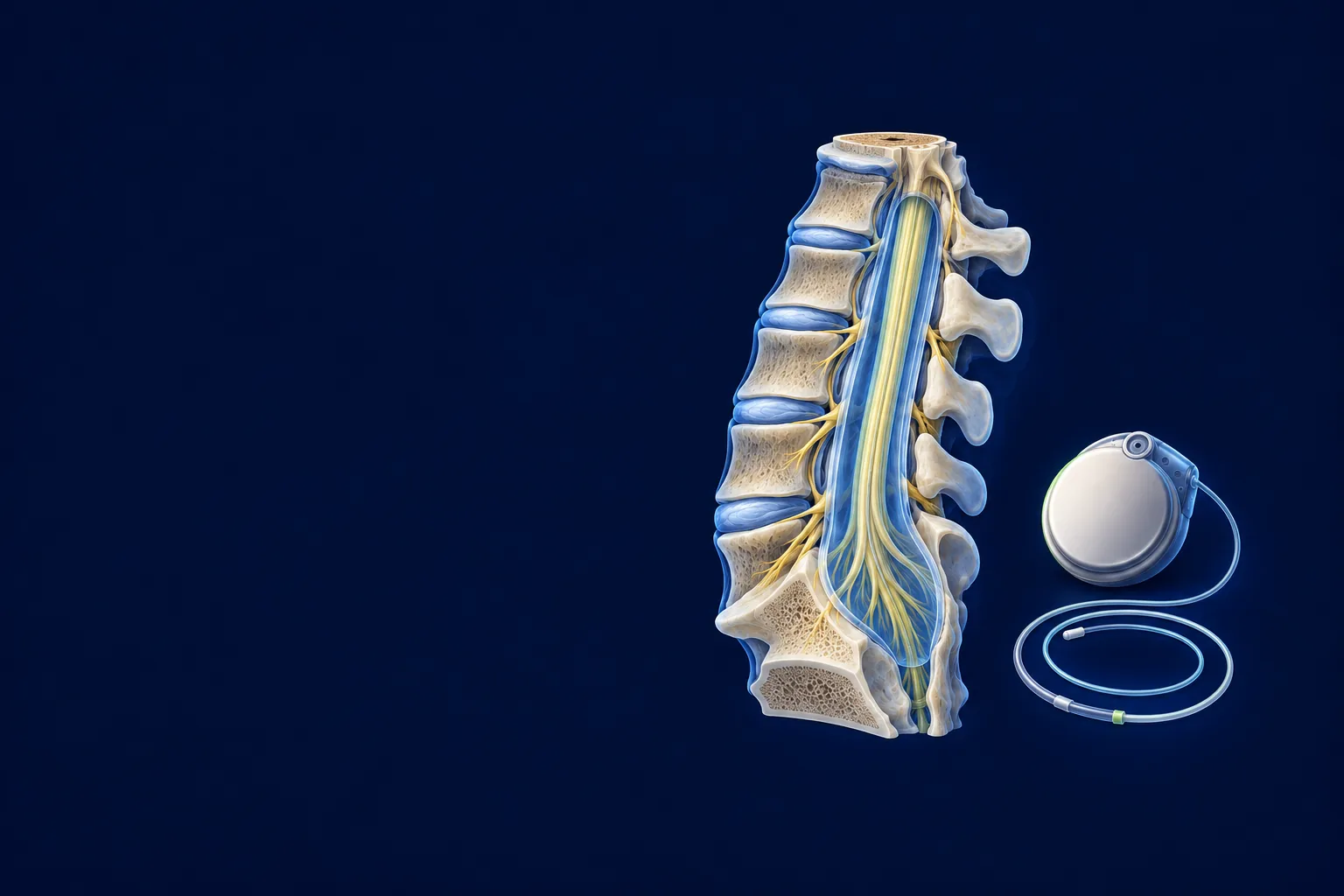
An intrathecal drug delivery system (pain pump) delivers medication directly into the intrathecal space surrounding the spinal cord through an implanted programmable pump. Working directly in the spinal fluid, it can control pain at significantly lower doses than oral medication requires, which reduces systemic side effects.
Conceptual illustration
Medically reviewed by Joshua L. Hare, DO, Founder & Medical Director
Updated August 2026
Conditions Treated
Severe chronic pain refractory to other treatments, cancer pain, failed back surgery syndrome, spasticity
The key facts
Intrathecal Drug Delivery at a Glance
| What it is | A programmable pump and spinal catheter delivering pain medication directly into the cerebrospinal fluid |
|---|---|
| Path to the implant | Two stages — a temporary trial first, the permanent implant only if the trial works |
| The implant procedure | 1–2 hours at our surgery center, under local anesthesia with sedation, or general anesthesia[1] |
| Refills | Office visits, through a thin needle into the pump's reservoir; the interval depends on the drug and dose |
| Pump battery | 5 to 7 years on average[1] before a planned replacement |
| Adjustable | Yes — the pump is programmed externally, so dosing changes without another procedure |
Talk with our team
Request a callback
The team calls you back within one business day, Monday to Thursday.
Insurance we acceptThe treatment explained
How It Works
A programmable pump is surgically implanted in the abdomen and connected to a catheter threaded into the intrathecal space.[1] The pump delivers precise doses of medication (typically morphine, hydromorphone, or ziconotide) directly to pain receptors in the spinal cord.
The reason to deliver medication there, rather than by mouth, is dose. Working directly in the spinal fluid, these systems can achieve effective pain control with significantly lower medication doses than oral or IV routes,[1] and a continuous infusion avoids the peaks and troughs of pill-based dosing. Three medications are FDA-approved specifically for intrathecal delivery — morphine, ziconotide and baclofen[1] (the last for muscle spasticity); your provider selects and adjusts what goes in the pump for your situation.
Candidates
Who a Pain Pump Helps — and Who It Does Not
These systems are typically for patients with chronic pain — cancer-related or not — or spasticity that has not reached treatment goals with more conservative care.[1] This is not a first-line treatment: it is the option your provider reaches for after simpler ones have had a fair trial, and candidacy is weighed carefully — the clinical literature emphasizes team-based patient selection[1] as critical to a good result.
Some situations rule it out or call for extra caution: bleeding disorders, active infection, and allergies to the implanted materials or medications[1] are contraindications, and a weakened immune system raises infection risk. Your evaluation covers all of these before any trial is scheduled.
The Trial Comes First
Nobody should carry an implanted device that was never shown to help them. Before any permanent implant, a temporary intrathecal catheter evaluates your actual response — and the permanent pump's starting dose is then derived from the test dose you responded to.[1] If the trial does not deliver meaningful relief, you have lost a few days, not undergone an implant, and other options stay on the table, including spinal cord stimulation.
Afterward
The Implant, and the First Weeks After
- The procedure. A 1–2 hour implant at our ambulatory surgery center, performed under local anesthesia with sedation, or general anesthesia.[1]
- Observation. A hospital or observation stay of 24–48 hours while the system settles and dosing begins.
- Healing restrictions. Activity limits for 4–6 weeks while the pump pocket and catheter heal — follow your discharge instructions on bending, twisting and lifting.
- Dialing it in. Dosing is adjusted through the external programmer over the following visits. Expect fine-tuning across several appointments rather than one perfect setting on day one.
Living With the Pump
Day to day, the system runs on its own. Refills are office visits — a thin needle introduced through the skin[1] into the pump's reservoir — and how often depends on your drug and dose; every 1–6 months is typical. The pump's battery averages 5 to 7 years,[1] and its replacement is planned with your provider well before it runs down. If your pain pattern changes, the delivery is reprogrammed — continuous, variable or patient-triggered supplemental dosing — without another surgery.
Clinical evidence
What the Evidence Shows
This is one of the older, better-studied tools in interventional pain: the first implanted pump delivered low-dose morphine for cancer pain in 1981,[1] and in the decades since, systematic reviews have found these systems effective and safe for cancer-related and chronic noncancer pain[1] — with complication rates reported as low, even though implantation is an invasive procedure. The trial comes before the implant for exactly this reason: you find out what the therapy does for your own pain before anything is placed permanently.
Safety
Risks and What to Watch For
Infection[1] is the concern around implantation. A catheter problem — a kink, obstruction or disconnection — often shows up as a fluctuation in how well the medication works,[1] and has a defined workup. Uncommonly, an inflammatory mass (granuloma) can form at the catheter tip; the literature ties that risk to higher opioid doses and faster dose increases[1] — one more reason the low-dose logic of intrathecal delivery matters. Report any sudden change in relief or new neurologic symptoms promptly.
Your questions
Common Questions
- Will I be able to stop taking pain pills?
- The goal of intrathecal delivery is effective relief at much lower doses than oral medication requires. What that means for your own prescriptions is individual, and your provider manages any reduction deliberately — never assume a medication change on your own.
- Is the trial reversible?
- Yes — that is its whole design. The trial uses a temporary catheter, and if it does not help, nothing has been implanted.
- What happens when the battery runs out?
- The battery averages 5 to 7 years, and its level is checked along the way, so replacement is a planned procedure rather than a surprise.
- What if my pain changes over time?
- The pump is reprogrammed externally — dose, rate and delivery pattern can all change at an office visit, without surgery.
References
Five clinics
Book a visit
Our fellowship-trained physicians are accepting new patients at five clinics: Dalton, Ringgold, Cleveland, Farragut and Oak Ridge.