

Epidural Injections
Lumbar Transforaminal Epidural Steroid Injection
A transforaminal epidural steroid injection (TFESI) delivers medication directly to a specific nerve root as it exits the spine through the neural foramen. It is the route we use when the pain is coming from one level.
Conceptual illustration
Medically reviewed by Joshua L. Hare, DO, Founder & Medical Director
Updated September 2026
Conditions Treated
Single-level lumbar radiculopathy, sciatica from a specific herniated disc, foraminal stenosis
| What it is | A corticosteroid, commonly dexamethasone, delivered into the epidural space at one irritated lumbar nerve root, with or without a local anesthetic[1] |
|---|---|
| Why it is called transforaminal | The path the needle takes: across the foramen, the opening a nerve root exits through[1] |
| Guidance | Live fluoroscopic x-ray, or less commonly CT, is the standard of care,[1] with contrast dye confirming placement before any medication follows |
| Anesthesia and monitoring | Local numbing alone, or intravenous sedation; either way a blood pressure cuff, cardiac monitor and pulse oximeter track your vital signs[1] |
| What it treats | Pain caused by irritation and inflammation of the spinal nerve roots[1] — the leg pain of lumbar radiculopathy |
| How long relief can run | Up to 12 months in some cases, pushing back the need for surgery[1] |
Talk with our team
Request a callback
The team calls you back within one business day, Monday to Thursday.
Insurance we acceptWhy This One Goes Through the Side Door
Every epidural steroid injection is named twice over: for the level of the spine treated, and for the route the needle takes into the epidural space.[1] This one is lumbar, by the transforaminal route. IPC uses the other two routes as well — between the bony arches, a lumbar epidural steroid injection, and up through the sacrum, a caudal epidural injection. The same transforaminal route is used with diagnostic intent in a selective nerve root block, where the aim is to identify which root is generating the pain.
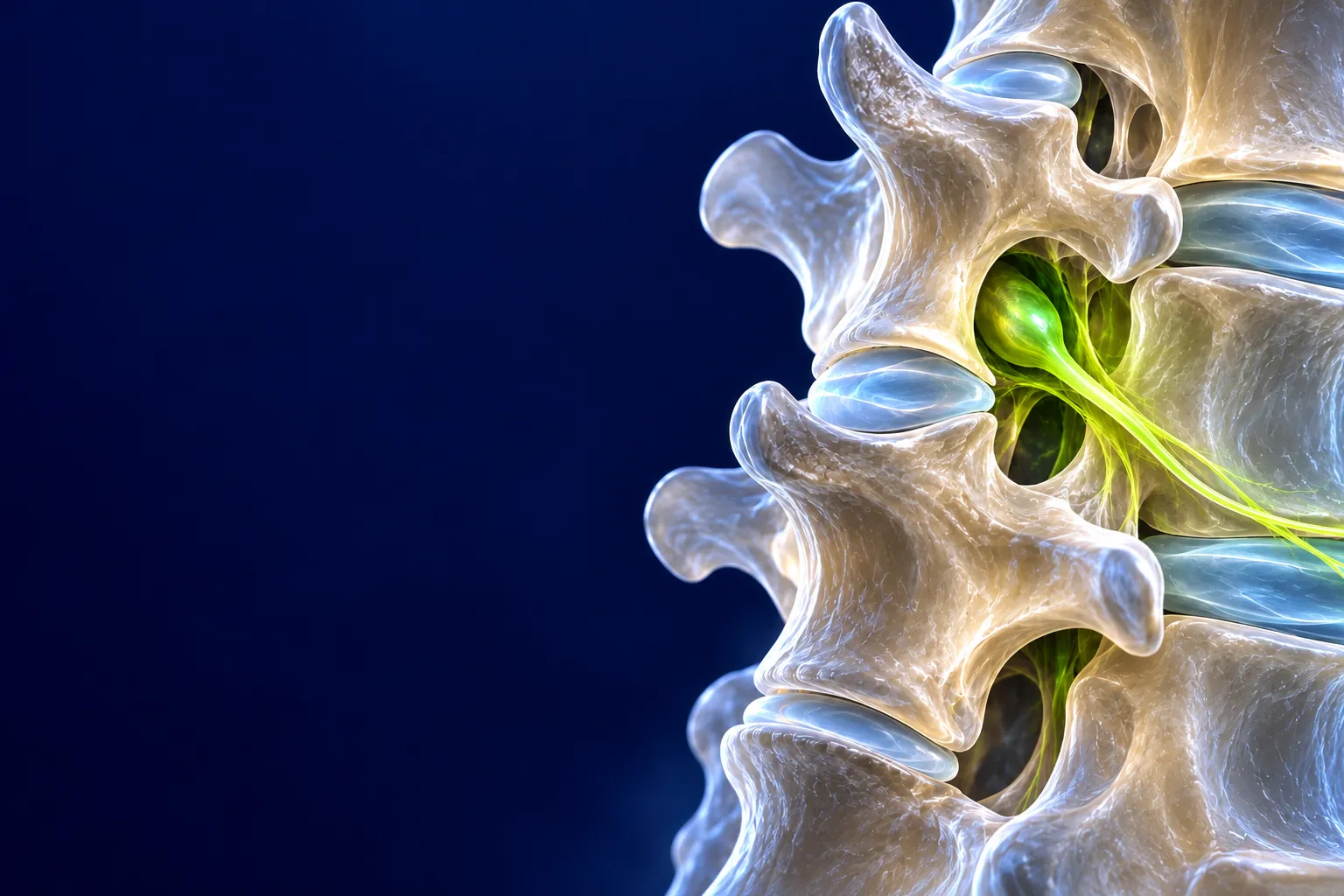
The transforaminal route is picked when the pain has a return address, because it puts the medication near the exiting spinal nerve, the front of the epidural space, and the dorsal root ganglion.[1] Nerve roots leave the spine through two side openings called intervertebral foramina, formed where neighboring vertebrae meet, and each is crowded: the disc in front, the facet joint behind, the pedicles above and below as roof and floor, and inside, two nerve roots joining into one spinal nerve alongside arteries, veins and epidural fat.[1]
What Is Actually Pressing on the Nerve
Usually the cause is mechanical. A nerve root is compressed by a herniated disc and then inflamed: the nucleus pulposus, the soft center of the disc, breaks through the annulus fibrosus and presses on the root beside it, producing pain, weakness and numbness along the path of that nerve.[1] That is why sciatica travels in a readable line down the leg instead of pooling in one spot.
Discs are the most common source. Spondylosis, spondylolisthesis and thickening of the ligamentum flavum all narrow the foramen and squeeze the nerve root the same way.[1] Spondylolisthesis is a vertebra slipped forward on the one below. Degenerative disc disease and spinal stenosis reach the same leg pain more slowly. Bring any MRI or CT you have; the level we inject is the one your imaging and your symptoms agree on.
When Pills and Time Have Not Moved It
Most people reading this have already tried the first answers. Among people with lumbosacral radiculopathy, more than half report that it interferes with their daily activities, a quarter still have severe pain that oral medication does not control well, and roughly 14% eventually need surgery for severe pain.[1]
The group in the middle — bad enough that the pills are not holding it, but short of surgery — is who this injection was built for. Epidural steroid injections have been used for pain from lumbar disc injuries since the 1950s,[1] and that group is why they are still in routine use. Anti-inflammatories, rest and physical therapy come first. Once they have had their turn, treating the inflamed root directly is the next step.
Consent, a Time-Out, and Who Is in the Room
Before anything begins, the risks and benefits are discussed with you and you sign a written consent form, and a time-out immediately before the needle verifies your identity and the correct site.[1] Both steps exist because wrong-site and wrong-patient errors are the preventable kind.
A published standard sets who is in the room: a physician trained in epidural steroid injections, a nurse or assistant, a fluoroscopic c-arm operator, and an anesthesia clinician who monitors you during the procedure, all of whom should be trained to manage the complications of the procedure.[1]
What Happens Once You Are Face Down
- You are face down on the fluoroscopy table, and the injection site is marked, cleaned with betadine and covered with sterile drapes.[1]
- The tube is angled until the foramen between the two vertebrae lines up on an oblique view — the view in which the vertebra takes the shape of a Scottie dog, the outline used to aim the needle.[1]
- Skin and deeper tissue are numbed with lidocaine or bupivacaine, the spinal needle is directed under the pedicle of the vertebra above the level treated, a side-view image checks its depth and keeps it away from the nerve root, and it stops at the outer edge of the intervertebral foramen.[1]
- Contrast dye goes in first, checked on both side and front views to confirm it is spreading through the epidural space.[1] Nothing else goes in until that picture is right. Then the steroid goes in, the needle is drawn out, and pressure is held over the site.
What the Needle Is Steering Around
The contrast picture is a safety step, and the reason is vascular. Each nerve root travels with its own radicular artery; avoiding them is a specific concern during a transforaminal injection, and defined needle approaches and protocols exist to reduce and detect an accidental injection into a blood vessel.[1]
One artery earns the caution on its own. The artery of Adamkiewicz is the largest, joins the anterior spinal artery and supplies the lower spinal cord; it runs on the left in 68% to 85% of people, sits in the upper or middle part of the foramen, and usually branches off around T9 though it varies and can arise as low as L5[1] — inside the range of levels this injection treats.
The medication is picked on the same reasoning. Non-particulate steroids such as dexamethasone are about ten times smaller than a red blood cell and do not clump together under a microscope, and in animal work particulate steroid injected into a blood vessel caused neurological injury while non-particulate steroid did not.[1]
What the Injection Is Meant to Buy You
The evidence here is specific to this route. A systematic review of eight randomized controlled trials produced a strong recommendation, on moderate-quality evidence, that transforaminal epidural steroid injections reduce pain at three months.[1] Where the radicular pain comes from a disc herniation, the evidence is good for steroid combined with local anesthetic, and a separate meta-analysis found good efficacy in spinal stenosis and lumbar radiculopathy.[1]
Relief is also the opening for the rest of the plan. A successful injection relieves pain, restores function, and lets you get back into a physical therapy program,[1] and the strengthening you do inside that window is what the plan is built around.
Safety
Risks and Side Effects
Complications are rare, and the list runs: bleeding, infection, an allergic reaction, nerve injury,[1] temporary numbness and tingling in the leg, a dural puncture causing a positional headache, an epidural abscess, an epidural hematoma, and temporary back or leg pain.[1] A positional headache is one that is worse when you sit or stand. Rare does not mean impossible, and the live imaging, the contrast check and the staffing standard exist because of it.
The steroid carries its own list: flushing or hot flashes, fluid retention, weight gain, a rise in blood sugar, mood changes, and suppression of the adrenal glands.[1] The blood sugar one matters most if you are diabetic.
Reasons We Would Wait, or Not Go Ahead
An infection anywhere in the body or at the injection site, a bleeding disorder or full anticoagulation, a significant allergic reaction to contrast, local anesthetic or corticosteroid, and cancer at the local site rule the injection out altogether, as does your own decision not to have it, while poorly controlled diabetes, congestive heart failure and pregnancy — the last because the procedure uses x-ray guidance — call for caution rather than refusal.[1]
So the list worth mentioning when you call is short: any blood thinner, how your diabetes is running, an active infection, a past reaction to contrast dye or a local anesthetic, and any chance you are pregnant. Say it at booking and the visit gets planned around it.
References
Clinical sources for this page.
Five clinics
Book a visit
Our fellowship-trained physicians are accepting new patients at five clinics: Dalton, Ringgold, Cleveland, Farragut and Oak Ridge.