

Sacroiliac Joint Procedures
SI Joint Fusion
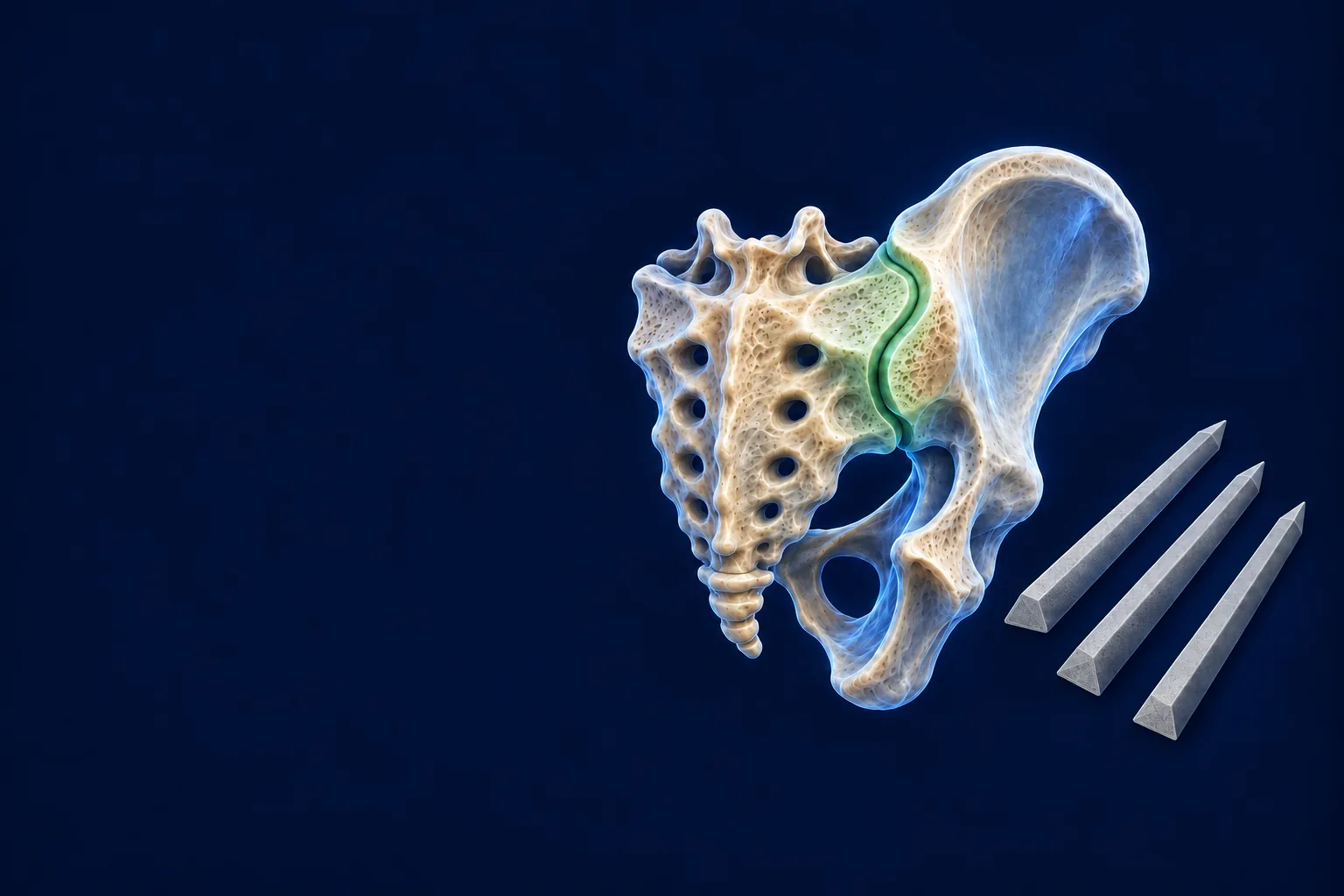
Minimally invasive SI joint fusion uses small titanium implants placed across the SI joint to stabilize it and reduce pain caused by joint instability or severe arthritis that has not responded to conservative treatments.
Conceptual illustration
Medically reviewed by Joshua L. Hare, DO, Founder & Medical Director
Updated August 2026
Conditions Treated
Chronic SI joint dysfunction refractory to injections and RF ablation, SI joint instability, sacroiliitis with joint degeneration
The key facts
SI Joint Fusion at a Glance
| What it is | Minimally invasive stabilization of the sacroiliac joint using triangular titanium implants[1] placed across the joint |
|---|---|
| Who it is for | Patients whose SI joint has been confirmed as the pain source and who have already exhausted injections and radiofrequency ablation |
| Evidence grade | Level 1 — a multicenter prospective randomized controlled trial[1] with two-year follow-up |
| Where it is done | Our ambulatory surgery center — you go home the same day |
| Time in the operating room | About 45-60 minutes |
| Recovery arc | Limited weight-bearing for 4-6 weeks, then a gradual return to full activity over 3-6 months as bone grows into the implants |
| Revisions in the trial | Only 3 of 102 surgical patients underwent revision surgery within 24 months[1] |
Talk with our team
Request a callback
The team calls you back within one business day, Monday to Thursday.
Insurance we acceptHow the Diagnosis Is Confirmed Before Fusion
Sacroiliac joint dysfunction is an important and underappreciated cause of chronic low back pain[1] — the joint sits at the junction of spine and pelvis, and pain from it is routinely mistaken for lumbar disc or hip trouble. That is why fusion comes last, after a deliberate sequence of confirmation. Before anyone discusses implants, the diagnosis has to be confirmed: image-guided diagnostic injections that reproduce and then abolish your pain, and usually a course of therapeutic injections and radiofrequency ablation first. Fusion enters the conversation only when the diagnosis is proven and the less invasive options have been used up. That selection discipline is why the trial results below look the way they do.
What Two Years of Trial Data Show
The INSITE trial randomized 148 subjects with SI joint dysfunction to minimally invasive fusion (102) or non-surgical management (46)[1] and followed them for two years.
| Pain relief | Mean SI joint pain improved rapidly and was sustained — a mean improvement of 55.4 points on a 100-point scale at month 24[1] |
|---|---|
| Against non-surgical care | The fusion group's improvement exceeded non-surgical management by 38.3 points (p<.0001 for superiority)[1] |
| How many benefited | By month 24, 83.1% achieved clinical improvement and 82.0% substantial clinical benefit in pain score[1] |
| Function | 68.2% achieved clinical improvement and 65.9% substantial clinical benefit in disability score at month 24[1] |
| Quality of life | Parallel gains on EQ-5D and SF-36, larger in the surgical group[1] |
| Safety | The rate of adverse events related to fusion was low[1] |
The comparison arm matters as much as the headline: patients randomized to continue non-surgical care alone — the medications and therapy most people on this page have already tried — reached those improvement thresholds less than 10% of the time.[1]
What the Implants Actually Do
Through an incision of an inch or two in the buttock, guided by fluoroscopy, the surgeon passes rigid triangular titanium implants across the joint from the outer pelvis into the sacrum. Because the profile is triangular, the implants resist rotation as soon as they are seated, controlling the joint’s painful micromotion; over the following months, bone grows onto and across the implants, converting that mechanical stability into biological fusion. The weight-bearing restrictions in the first 4-6 weeks exist to protect exactly that process while it takes hold.
Treatment day
The Procedure, Step by Step
- Anesthesia is administered at our ambulatory surgery center and you are positioned face down.
- A small incision is made over the outer buttock.
- Under fluoroscopic guidance, guide pins establish the trajectory across the SI joint.
- The triangular implants — typically three — are placed across the joint and their position is confirmed on imaging.
- The incision is closed; most patients go home the same day with a walker or crutches ready.
- Weight-bearing advances gradually over 4-6 weeks, with full activity returning over 3-6 months as the fusion matures.
Safety
Risks and Side Effects
Every surgery carries risk — infection, bleeding, nerve irritation, anesthesia reactions — and this one adds the specific possibilities of implant malposition and, uncommonly, the need for revision. The trial put numbers on that: adverse events related to the fusion were infrequent, and 3 of 102 surgical patients required revision within two years.[1] Surgical soreness at the incision is expected for the first weeks, and the early weight-bearing limits mean you should plan for help at home. Your surgeon will review your individual risk profile with you — bone quality, medications, and health conditions all factor in.
Your questions
Common Questions
- How do I know my SI joint is really the problem?
- By testing it directly. The diagnosis is confirmed with image-guided injections into the joint itself: if numbing the joint reliably switches your pain off, the source is established. Fusion is only discussed once that confirmation exists.
- Why must injections and ablation come first?
- Because many patients get durable relief from them and never need surgery at all. Fusion is permanent, so it is reserved for patients whose pain has come back after every less invasive option. The trial enrolled its patients through the same kind of screening.
- How soon will I walk normally?
- You will be up with support almost immediately, but weight-bearing through the fused side stays limited for 4-6 weeks. Most patients then progress steadily, with full, unrestricted activity typically returning over 3-6 months as bone locks the implants in.
- Do the implants ever come out?
- They are designed to stay for life — bone grows across them, which is the fusion. Revision is uncommon: three patients out of 102 needed one within the trial's two-year window.
References
Clinical sources for this page.
Five clinics
Book a visit
Our fellowship-trained physicians are accepting new patients at five clinics: Dalton, Ringgold, Cleveland, Farragut and Oak Ridge.