

Nerve Blocks
Occipital Nerve Block
An occipital nerve block involves injecting local anesthetic and sometimes corticosteroid around the greater and lesser occipital nerves at the base of the skull to treat headaches originating from these nerves.
Conceptual illustration
Medically reviewed by Joshua L. Hare, DO, Founder & Medical Director
Updated August 2026
Conditions Treated
Occipital neuralgia, cervicogenic headaches, chronic migraines with occipital involvement, tension-type headaches
The key facts
Occipital Nerve Block at a Glance
| Type of procedure | Office injection, no imaging required — the landmarks are felt by hand |
|---|---|
| Anesthesia | The injected anesthetic is itself the numbing; no sedation and no fasting |
| Time in the room | About 5–10 minutes, including the pressure held afterwards |
| When relief starts | Pain typically improves after 20 to 30 minutes[1] |
| How long it lasts | Several hours to several months,[1] and the range is genuinely that wide |
| Back to activity | Immediately — you drive yourself home |
| How often | Repeatable. If you are needing them often, that is a prompt to review the wider headache plan with your physician |
Talk with our team
Request a callback
The team calls you back within one business day, Monday to Thursday.
Insurance we acceptWhy a Nerve at the Base of the Skull Causes Headaches
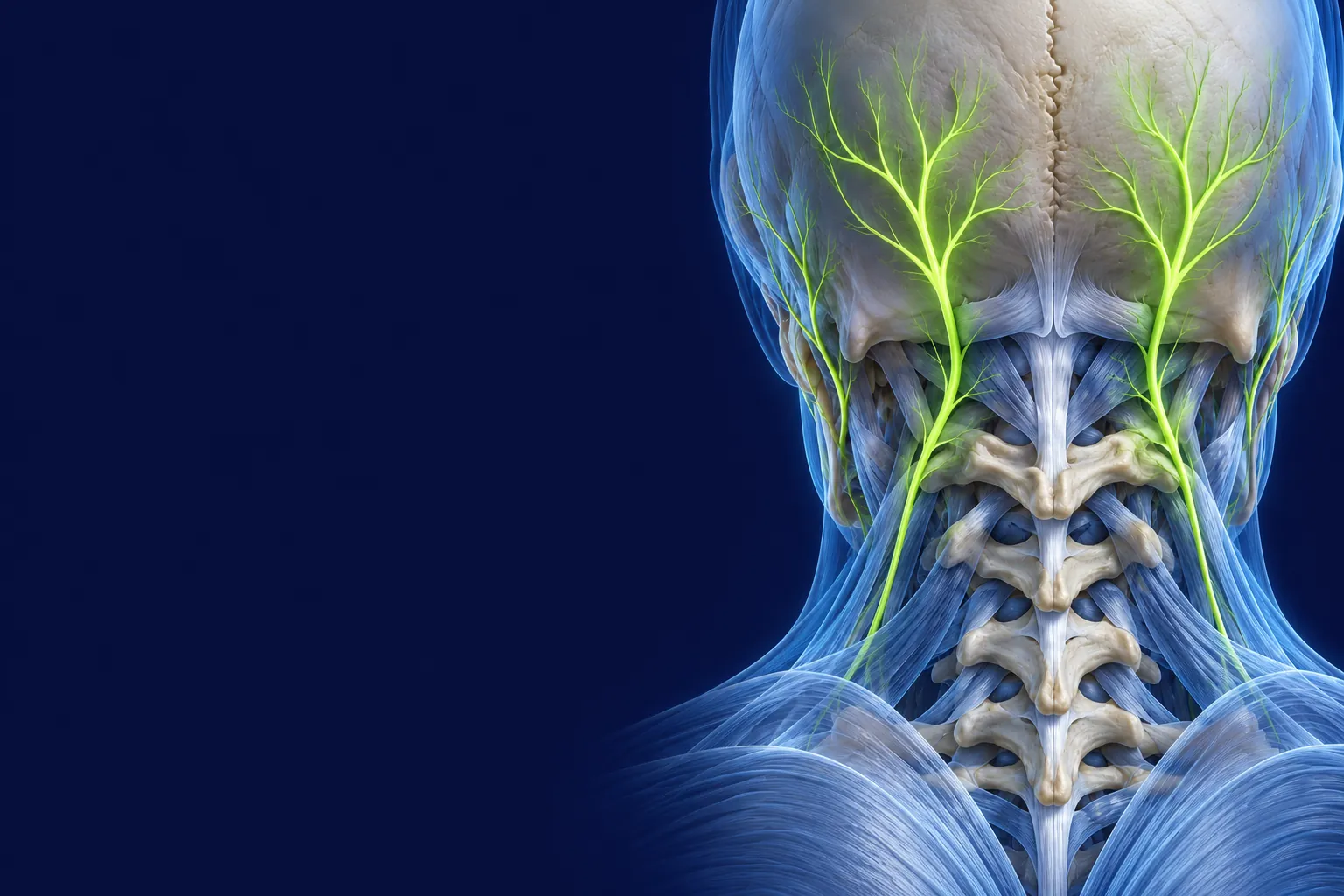
Three nerves supply the back of the scalp, and the largest is the greater occipital nerve. Its fibers arise from the dorsal primary ramus of the C2 spinal nerve[1] — that is, from the upper neck — then wind up through muscle and emerge just below the ridge of bone at the back of the skull. The reference calls it a torturous path,[1] and it is that winding route through muscle that leaves the nerve open to irritation and compression.
This also explains something patients often describe and rarely get explained: why the neck and the head hurt together. The C2 fibers of this nerve share common sensory innervation with the trigeminal nucleus caudalis, creating a common nociceptive pathway between the head and neck.[1] Head and neck pain arrive at the same relay station, so a problem in one is felt in the other.
Which Headaches It Is Used For
The block is used for occipital neuralgia, migraine, postdural puncture headache, cervicogenic headache, and cluster headache.[1] It can be a first treatment, but is more often used to treat intractable headaches when other methods have failed.[1]
Two findings on examination predict a better response. Patients who report allodynia of the scalp and those who have reproducible pain with palpation of the GON are most likely to achieve the desired analgesic response[1] — in plainer terms, if the scalp is tender to light touch, or if pressing a specific spot at the base of your skull reproduces your headache, that is a useful sign. Mention either of those when you come in — both are easy to miss unless someone goes looking for them.
The block is also a viable treatment option for headaches in the elderly and pregnant population who have comorbidities that prevent them from receiving other first-line treatment regimens,[1] which matters when the usual headache medications are ruled out.
Treatment day
The Injection, Step by Step
- Positioning. You sit up or lie face down with the neck bent slightly forward.
- Finding the nerve. The bump at the back of the skull and the bone behind the ear are located by hand; the nerve sits approximately one-third of the distance from the occipital protuberance to the mastoid process.[1]
- Cleaning. The area is cleaned with an antiseptic solution.
- The injection. A fine needle is advanced until it touches bone, then withdrawn approximately 1 mm,[1] and the physician draws back on the syringe to be sure the occipital artery has not been entered before injecting.
- Pressure. The needle comes out and pressure is applied for 5 to 10 minutes.[1] Then you go home.
Blocks can be done on one side or both. No approach has been shown superior, so the choice follows where your pain actually is.
Anesthetic Alone, or Anesthetic With Steroid
Whether a steroid is added is a real decision rather than a formality, and the answer depends on your headache type. Study results suggest no difference in short and long-term migraine pain control when the anesthetic is injected alone or in combination with a steroid.[1] For other headache types the picture differs: the addition of steroids is very effective for treating cluster, cervicogenic, and postdural puncture headaches.[1]
So a migraine patient may reasonably be offered anesthetic on its own, while someone with cluster or cervicogenic headache is more likely to be offered the combination. If you have had a block elsewhere that did little, it is worth knowing which you were given.
What Relief Looks Like
When the block works, pain typically improves after 20 to 30 minutes[1] and the relief can run from several hours to several months.[1] Patients who describe a tender scalp, or whose headache is reproduced by pressing over the nerve, are the ones most likely to get that response — which is why the exam matters as much as the injection.
How long the first block holds is useful information in its own right, because it shapes what comes next: repeating the block on a planned schedule, adding a steroid, or moving to a longer-acting option for the same nerve. Headaches are common enough to get dismissed as ordinary: approximately 1.4% to 2.2% of the global population experiences headaches at least 15 days per month,[1] which is a great many people living around a problem that has a name, a workup and treatments.
Safety
Risks and Side Effects
This is an overall safe procedure[1] and most adverse effects are mild and transient.[1] The usual ones are pain, redness, and swelling at the injection site,[1] sometimes with dizziness or lightheadedness for a short while afterwards. A brief worsening of the headache can happen before it settles.
One side effect is worth flagging in advance because it surprises people: if a steroid is used, patients may also experience alopecia at the injection site[1] — a small patch of hair thinning where the injection went in. Absolute reasons not to proceed are few: patient refusal, anesthetic allergy, open skull defect, and infection at the procedure site.[1] Blood thinners and a history of Chiari malformation are weighed case by case, so bring your medication list and any prior brain or neck imaging.
Your questions
Common Questions
- Will my scalp go numb?
- Usually yes, over the back of the head on the treated side, and it wears off with the anesthetic over a few hours. Numbness is expected and is not a sign anything has gone wrong.
- Is this the same as Botox for migraine?
- No. A nerve block puts anesthetic beside one named nerve and can work the same day; Botox for headache is given as many small injections across the head and neck on a repeating schedule and works to prevent headache days over weeks. They answer different questions and are sometimes used together.
- How many can I have?
- There is no fixed allowance, but the clinical reference sets a sensible checkpoint: needing more than three within six months is a prompt to reassess rather than to book a fourth.
- Do I need a scan first?
- Not for the block itself, which is done by feel rather than by imaging. Imaging may still be part of working out why the nerve is irritated, particularly where the upper neck is involved — bring any scans you already have.
References
Clinical sources for this page.
Five clinics
Book a visit
Our fellowship-trained physicians are accepting new patients at five clinics: Dalton, Ringgold, Cleveland, Farragut and Oak Ridge.