

Neuromodulation
Spinal Cord Stimulation
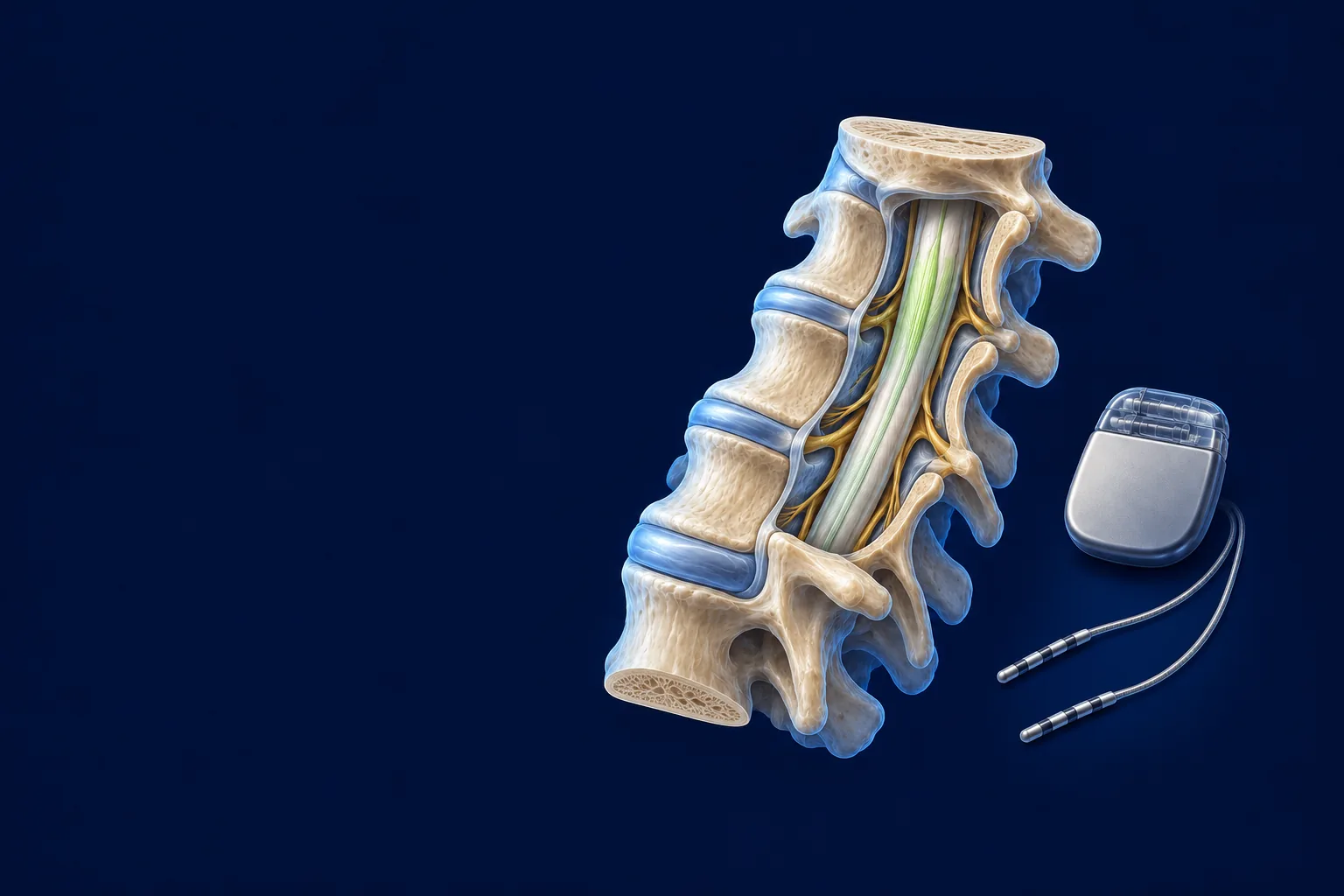
Spinal cord stimulation (SCS) uses mild electrical impulses delivered through small leads placed in the epidural space to modify pain signals before they reach the brain. It is considered for chronic pain that has not responded to conservative therapies, and begins with a 5-10 day trial before any permanent implant.
Conceptual illustration
Medically reviewed by Joshua L. Hare, DO, Founder & Medical Director
Updated August 2026
Conditions Treated
Failed back surgery syndrome, chronic radiculopathy, complex regional pain syndrome (CRPS), peripheral neuropathy, chronic back and leg pain refractory to other treatments
The key facts
Spinal Cord Stimulation at a Glance
| Type of procedure | Two stages — a temporary trial first, then a permanent implant only if the trial works |
|---|---|
| Where it is done | Both stages are sterile procedures under monitored sedation; the permanent implant is done at our ambulatory surgery centers in Dalton and Cleveland |
| Trial length | You return to the clinic within 10 days[1] of the trial procedure |
| What counts as success | At least a 50% reduction in pain and/or a 50% improvement in function,[1] with coverage of all your painful areas |
| Where the leads sit | The mid-thoracic spine, most commonly between T8 and T10,[1] adjusted to your own pain pattern |
| Before the implant | A psychological evaluation is a standard prerequisite[1] |
| Battery | Rechargeable generators are designed to last up to 10 years[1] |
Talk with our team
Request a callback
The team calls you back within one business day, Monday to Thursday.
Insurance we acceptWhy It Happens in Two Stages
Almost everything that makes spinal cord stimulation unusual follows from one fact: you get to test it before you commit to it. The implant is divided into 2 steps: the trial and the permanent SCS implantation,[1] and the first exists so that you and your physician can find out whether stimulation actually helps your pain before any device is placed under the skin.
During the trial, one or more temporary leads are threaded into the epidural space and connected to a generator you wear on the outside. You go home with it and live your ordinary week — work, sleep, stairs, whatever normally hurts. The trial is the part of this procedure that answers the question, and it is the reason a stimulator is not a leap of faith in the way spine surgery can be.
Candidates
Who It Helps Most
The strongest evidence sits behind a short list of diagnoses. Level A evidence supports SCS for failed back surgery syndrome, also known as postlaminectomy syndrome, peripheral ischemia, peripheral neuropathy, and angina pectoris.[1] Failed back surgery syndrome — pain that persists or returns after spine surgery — is the most common indication for SCS in the United States.[1]
Complex regional pain syndrome is among the most predictive indications for favorable outcomes.[1] Beyond those named diagnoses, stimulation has shown benefit across a range of nerve-related and radiating pain problems, particularly where medication, physical therapy and injections have already been tried without lasting result. Notably, patient age, pain duration, intensity, or laterality do not appear to influence SCS outcomes significantly,[1] so being older or having hurt for a long time does not by itself rule you out.
Treatment day
The Trial, Step by Step
- Preparation. You shower with chlorhexidine beforehand. The procedure is done as a sterile operation under monitored sedation, lying face down.
- Reaching the epidural space. A needle is guided in under continuous fluoroscopic guidance,[1] at a shallow angle so the lead can pass smoothly.
- Placing the lead. The lead is advanced to the level that covers your pain, guided by testing during the procedure — which is why sedation is kept light enough for you to give feedback.
- Securing it. The lead is anchored at the skin and connected to an external generator, and device programming is initiated intraoperatively and finalized in the recovery room before discharge.[1]
- The week that follows. You go home and use the device through normal daily activity, then return to report what changed.
This percutaneous approach is the most commonly performed[1] one. It needs no incision, which keeps the trial itself more comfortable and carries a lower risk of infection compared to a permanent trial approach.[1]
The threshold is specific and it is written down in advance. If the week produces over 50% pain relief, an increase in activity level, and/or a decrease in medication use,[1] the trial counts as successful and a permanent implant can be scheduled. If it does not, nothing further is implanted, and the week has cost you a needle and a dressing rather than surgery.
Bring back specifics rather than an overall impression. How far you walked, how you slept, what you stopped taking, and whether the stimulation reached every area that hurts all matter, because coverage of all painful regions is part of the definition of success.
Clinical evidence
What the Evidence Shows
| Failed back surgery syndrome vs repeat surgery | In a randomized comparison, pain relief of more than 50% was achieved in 47% of those with SCS versus 12% in the reoperation group,[1] with higher opioid use after reoperation. |
|---|---|
| Failed back surgery syndrome vs medical management | At 6 months, 48% of those with SCS achieved greater than 50% pain relief, compared to 9% in the traditional medical management group.[1] The benefits persisted at 24 months. |
| Complex regional pain syndrome | In 42 patients, adding stimulation to physical therapy produced significant pain relief[1] at 6 months and the effect held at 2 years, though functional outcomes did not differ.[1] |
| Newer stimulation patterns | A 2024 network meta-analysis found newer approaches outperformed conventional medical management at 6 months[1] on responder rates, back and leg pain, quality of life and disability. |
| Closed-loop systems at 3 years | The EVOKE trial reported 77.6% of patients achieving ≥50% pain relief[1] at 36 months with closed-loop stimulation, against 49.3% with the open-loop comparison. |
Those are strong numbers for pain that has already outlasted surgery and medication, and they come from patients selected the same way we select ours. The trial is what turns a published result into an answer about your own pain, before anything permanent is placed.
Selection is most of why the results look like that. Complex regional pain syndrome is among the most predictive indications for favorable outcomes,[1] and a psychological evaluation before implant is a standard part of planning that helps match the therapy to the people it serves best. Worth knowing if you have wondered: catastrophizing, the tendency to expect the worst, does not appear to impact SCS outcomes negatively.[1]
Living With the Device
A stimulator asks something of you after it is placed. You will come in for reprogramming, keep the incisions clean while they heal, and with a rechargeable system, charge it on a routine. Long-term success depends as much on patient engagement[1] as on the technical side of the implant.
For the first one to two months you limit bending, lifting and twisting while the leads scar into position. Staples usually come out about 14 days[1] after the implant. If you expect to need MRI scans, raise it before the device is chosen: full-body MRI at 1.5 Tesla is generally supported; however, only certain SCS systems allow scanning at 3.0 T.[1] The generator pocket is placed for your comfort — typically above or below the beltline, on the side you do not sleep on and can reach to recharge.
Safety
Risks and Side Effects
The most frequent problem is mechanical rather than medical: lead migration or breakage,[1] which is what the early activity restriction is for. Infection is the most common complication that cannot simply be adjusted, running between 3% and 5%,[1] most often at the generator pocket, and usually requiring removal of the system when it occurs.
Serious complications — epidural bleeding, nerve injury, paralysis — are exceedingly rare,[1] and continuous fluoroscopy throughout the procedure is part of how that risk is kept low. Blood thinners need planning around in advance, and an infection anywhere near the surgical site postpones the procedure.
Your questions
Common Questions
- What happens if the trial does not work?
- The temporary leads are removed in the clinic and nothing is implanted — no incision, no device, no surgery to undo. That is the whole point of trialling first, and your physician comes out of the week knowing something concrete about your pain that guides the next step.
- Will I feel a tingling sensation?
- It depends on the program. Traditional stimulation replaces pain with a light tingling; newer subperception settings aim to relieve pain without a sensation you can feel. Which suits you is part of what programming after the implant works out.
- Is the implant reversible?
- Yes. Nothing in the spine is cut or destroyed, and the system can be removed if it stops helping or causes a problem. That is a genuine difference from surgery that changes the anatomy.
References
Clinical sources for this page.
Five clinics
Book a visit
Our fellowship-trained physicians are accepting new patients at five clinics: Dalton, Ringgold, Cleveland, Farragut and Oak Ridge.