

Facet Joint Procedures
Medial Branch Block
A medial branch block is a diagnostic injection that temporarily numbs the small medial branch nerves that transmit pain signals from the facet joints. It is primarily used to confirm that facet joints are the source of pain before proceeding to radiofrequency ablation.
Conceptual illustration
Medically reviewed by Joshua L. Hare, DO, Founder & Medical Director
Updated August 2026
Conditions Treated
Suspected facet joint pain in the cervical, thoracic, or lumbar spine (diagnostic confirmation before RF ablation)
The key facts
Medial Branch Block at a Glance
| Purpose | Diagnostic — it answers a question rather than treating the problem |
|---|---|
| Type of procedure | Outpatient, fluoroscopy-guided |
| Anesthesia | Skin numbed only. Sedation is ideally avoided as it may confound the patient's response[1] |
| Time in the room | About 15–20 minutes |
| What is injected | Local anesthesia only[1] — no steroid, because a steroid would blur the result |
| What counts as positive | Each test block needs to provide > 80 % analgesia for the duration of the local anesthetic used[1] |
| Your job afterwards | Track your pain for 4–8 hours in a diary. That record is the result |
Talk with our team
Request a callback
The team calls you back within one business day, Monday to Thursday.
Insurance we acceptWhy Two Nerves Are Numbed for One Joint
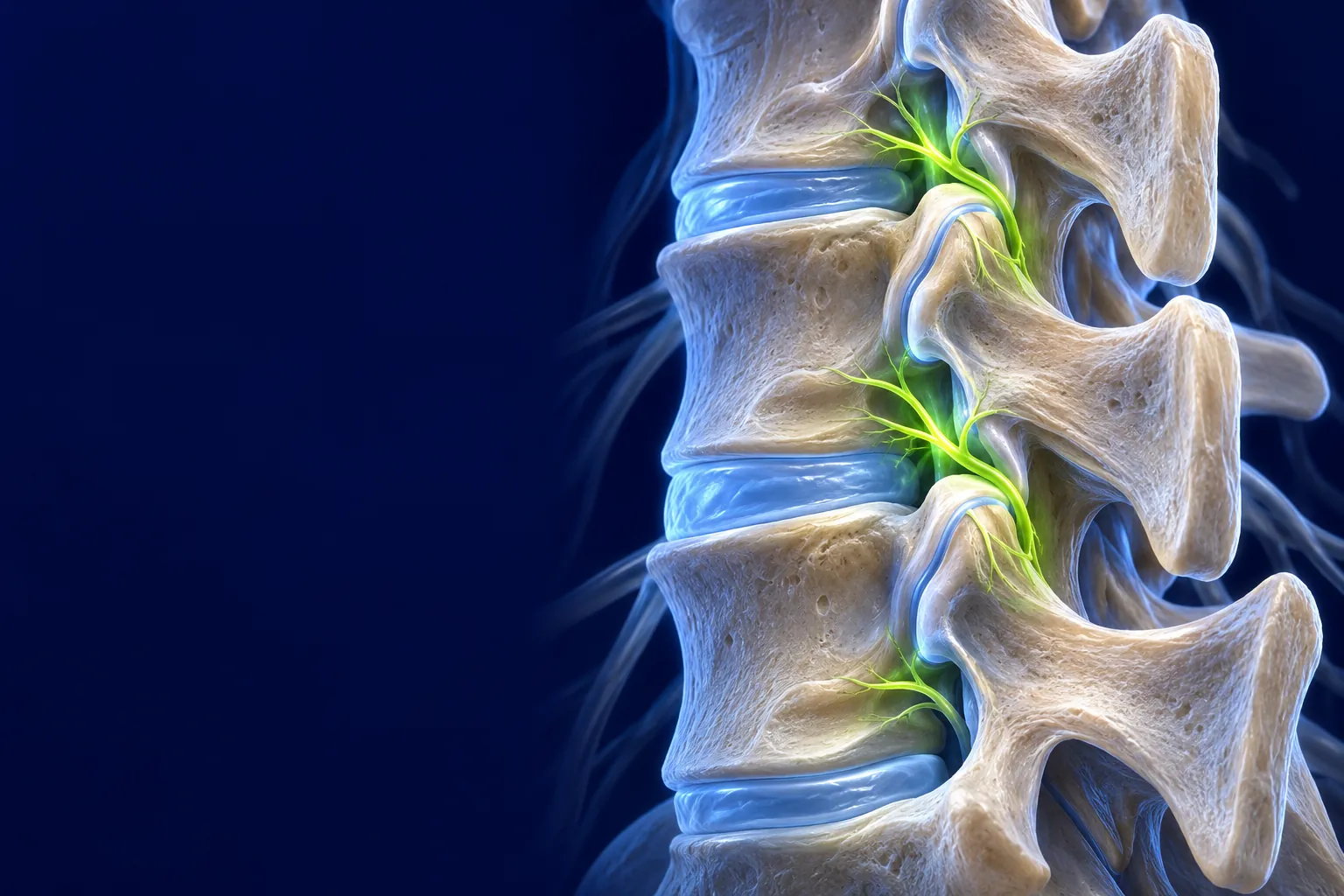
The small joints down the back of the spine each carry a nerve supply that surprises most patients: sensory information is provided through dual innervation from the spinal nerve at the same level and one level above.[1] One joint, two nerves. That single fact governs the whole procedure — numbing only one of the pair would leave the joint half-reporting, and the test would read as a failure when the joint was the culprit all along.
So a block aimed at one facet joint means two small injections, and a block aimed at two neighboring joints usually means three. When the consent form lists more injections than joints, this is why.
Why the Diagnosis Needs a Test at All
Facet joints are a common source of spine pain and a difficult one to prove. Estimates put facet joints behind pain in up to 67% of patients with neck pain, 48% of patients with thoracic pain, and up to 45% of patients with low back pain.[1] Yet imaging cannot settle it: scans in people with facet pain may be completely normal or show degenerative findings,[1] and degenerative findings turn up in plenty of people with no pain at all.
The result is that facet joint pain is a diagnosis of exclusion after other etiologies have been ruled out.[1] One question does a lot of the early sorting — does your pain extend below the knee or beyond the elbow?[1] A yes makes facet disease less likely and points elsewhere, because facet pain tends to stay close to the spine rather than travel down a limb. Before test blocks are considered, the guidance is that conservative treatments are trialed for at least 3 months.[1]
Treatment day
The Block, Step by Step
- Positioning. You lie face down, often with a pillow under the abdomen to open up access to the joints. Neck blocks may use a different position.
- Locating the targets. The levels are identified under fluoroscopy, and the skin over each is marked, cleaned and draped.
- Numbing the skin. Local anesthetic goes into the skin and the tissue beneath it.
- The injections. A fine needle is guided to each medial branch in turn and a small volume of anesthetic is placed on the nerve. Contrast may be used to confirm position.
- Straight into the diary. You are up and moving shortly afterwards, and the recording window starts immediately.
You stay awake on purpose. Sedation makes people feel better regardless of whether the right nerve was numbed, and that is precisely the confusion this test exists to avoid.
The Diary Is the Result
This is the part patients most often get wrong, and it is the part that decides everything downstream. For the next four to eight hours, record your pain at intervals — ideally with a number, the time, and what you were doing. Go and test the movements that normally hurt. A block that is never stress-tested against real activity produces a diary that says very little.
The bar is deliberately high: better than 80% relief while the anesthetic is working. Holding to that threshold is what makes the result worth acting on, and it is why the patients who go forward to ablation from here are the ones most likely to do well. Timing matters as much as the number — the anesthetic is long gone by the next day, so what you record inside the window is what counts.
What Happens Next
The value of testing first is precision. The discs, the sacroiliac joint, the nerve roots and the muscles can all produce back or neck pain, each has its own treatment here, and this block is how we aim at the right one from the start rather than working through them in turn.
A positive block points to radiofrequency ablation, which treats the same medial branches for far longer than an anesthetic can. Note that an injection into the joint itself does not substitute for this test — the reference is explicit that intra-articular facet joint injection does not serve as a diagnostic block in preparation for radiofrequency ablation,[1] because the ablation treats the nerve itself, while an injection into the joint puts medication in the joint space instead. Many insurers require two positive blocks on separate occasions before approving ablation, which guards against a single misleading result.
It is fair to say that the details here are still argued over by the specialists themselves. The multispecialty consensus guideline on lumbar facet pain reached 100% consensus achieved by committee members on all topics[2] across 17 questions, and the only points a participating society dissented on were number of blocks and cut-off for a positive block before RFA[2] — the two things patients most often ask about. The same guideline concluded that ablation may provide benefit to well-selected individuals, with MBB being more predictive than IA injections[2] — and that more stringent selection criteria are likely to improve denervation outcomes,[2] which is why we hold to the 80% threshold rather than a looser one.
Safety
Risks and Side Effects
Facet joint procedures are considered to be moderate to low risk,[1] and image-guided complications are rare.[1] Expect tenderness where the needles went in; swelling and pain at the needle insertion site typically resolve spontaneously and only last a short period.[1] Temporary numbness or a heavy feeling near the treated levels is expected while the anesthetic lasts.
Rarer problems include bleeding, infection and irritation of a nerve root. In a large review of adverse events, major complications were rare and typically related to infections in patients over the age of 60 years old with underlying risk factors.[1] There are no absolute contraindications besides patient refusal,[1] with infection, bleeding disorders, contrast allergy and pregnancy weighed individually — so tell us what you take and whether you might be pregnant.
Your questions
Common Questions
- Why can I not have sedation?
- Light sedation is sometimes used for anxiety, but it is avoided where possible because it can make you report less pain independently of whether the correct nerve was numbed. Since the whole procedure exists to measure your pain response, anything that clouds that measurement works against you.
- My pain came back after a few hours. Is that expected?
- Yes, and it is the result we want to see. The anesthetic is short-acting, so pain returning on schedule after a strong stretch of relief is the signature of a positive block and the green light for ablation.
- Why is there no steroid in it?
- A steroid can give relief lasting days to weeks, which would make it impossible to tell what the anesthetic alone did in its own short window. Keeping it out is what keeps the answer clean.
- Why do I need two of these?
- A single block can mislead — people can improve for reasons unrelated to the nerve that was numbed. Repeating it on a separate day and getting the same answer makes a false positive far less likely, and most insurers require the pair before approving ablation.
References
Clinical sources for this page.
- Facet Joint Injection. StatPearls [Internet], National Library of Medicine; updated June 20, 2023. Back to first citation ↑
- Cohen SP, Bhaskar A, Bhatia A, et al. Consensus practice guidelines on interventions for lumbar facet joint pain from a multispecialty, international working group. Regional Anesthesia and Pain Medicine. 2020;45(6):424–467. Back to first citation ↑
Five clinics
Book a visit
Our fellowship-trained physicians are accepting new patients at five clinics: Dalton, Ringgold, Cleveland, Farragut and Oak Ridge.