

Neuromodulation
Peripheral Nerve Stimulation
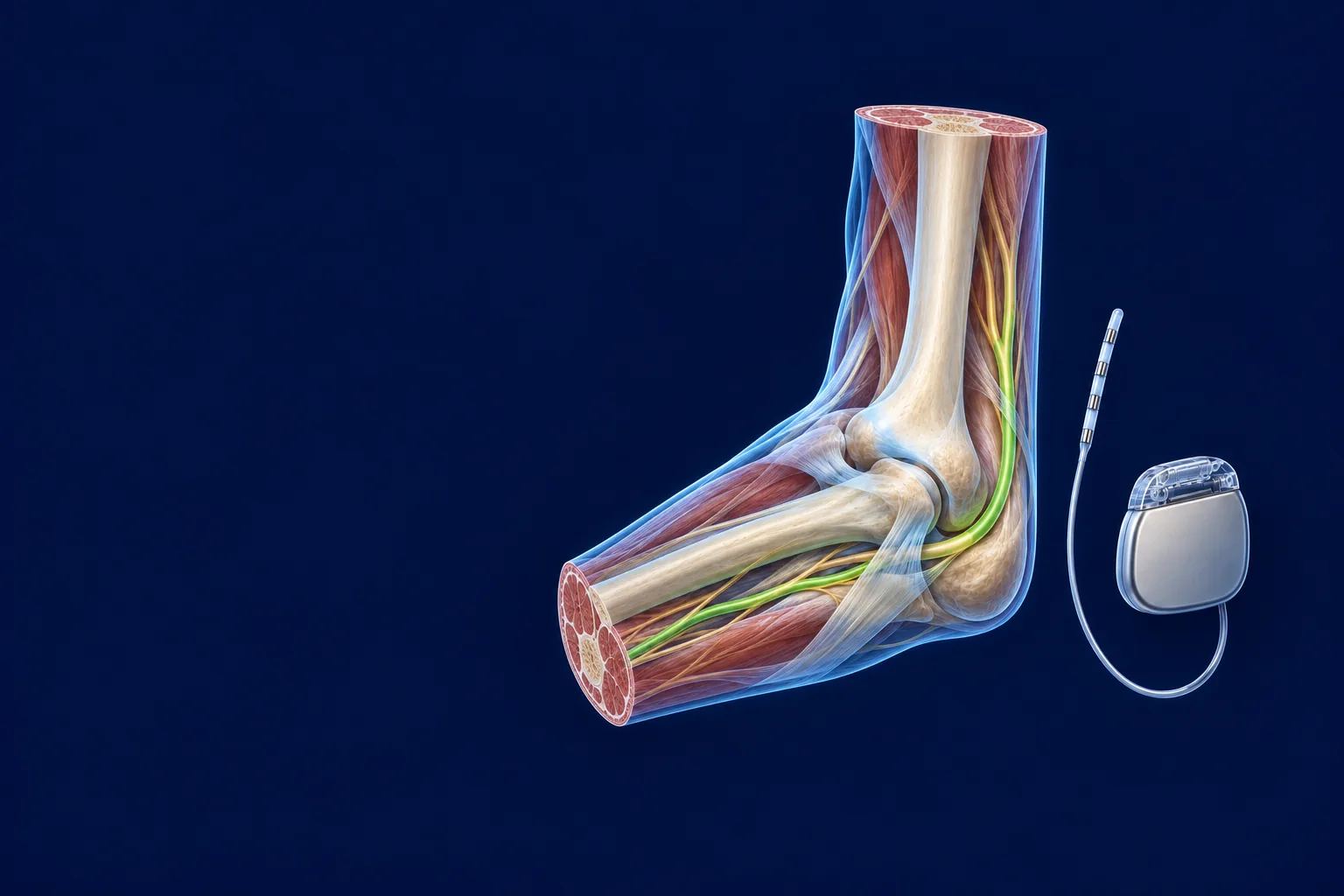
Peripheral nerve stimulation (PNS) involves placing small electrodes near a specific peripheral nerve to deliver mild electrical impulses that modulate pain signals from that nerve. It can be used for chronic pain in specific areas of the body.
Conceptual illustration
Medically reviewed by Joshua L. Hare, DO, Founder & Medical Director
Updated October 2026
Conditions Treated
Occipital neuralgia,[1] chronic post-surgical pain, peripheral nerve injuries, chronic headaches, post-amputation pain
| How it works | Mild electrical pulses through a thin lead placed about 0.5 to 1 cm from the target nerve[2] that supplies the painful area |
|---|---|
| Two approaches | A temporary lead withdrawn after up to 60 days,[2] or a permanent lead connected to an implanted pulse generator |
| Guidance | Ultrasound or live X-ray, as a minimally invasive outpatient procedure |
| In a placebo-controlled trial | For pain after amputation, participants given eight weeks of stimulation reported ≥50% reductions in average weekly pain at 12 months (67%, 6/9)[3] |
| Recovery | Minimal for the lead placement; avoid excessive movement of the implant area for 2 to 4 weeks |
| Main risks | Infection, bleeding/hematoma formation, surgical site pain, and nerve injury,[2] plus lead movement or breakage |
Talk with our team
Request a callback
The team calls you back within one business day, Monday to Thursday.
Insurance we acceptThe treatment explained
How Peripheral Nerve Stimulation Works
With peripheral nerve stimulation (PNS), the determination of the nerve to be stimulated corresponds to the area where pain relief is required,[2] and any focal area of pain in the body can be managed by stimulation of the peripheral nerve supplying that particular dermatome,[2] the area of skin that one nerve supplies. In 1976, Campbell et al published the first set of clinical studies on pain management using PNS,[2] and percutaneously implanted PNS leads and neurostimulators have been cleared by the US Food and Drug Administration since 2015.[2]
The mechanism is not fully understood, but the idea originates from the "gate control theory."[2] In its simplest form, an electrical stimulus is applied to A-beta fibers (which carry nonpainful stimuli) in the peripheral nerve, blocking the impulses carried by C fibers (which carry painful stimuli).[2] Other proposed mechanisms include the inhibition of wide-dynamic-range hyperexcitability via GABA release,[2] and some evidence suggests pain relief is secondary to stimulation-induced release of serotonin, adenosine, and noradrenaline.[2]
The stimulation is felt as a tingling, called paresthesia, and the electrode is tested intraoperatively to assess the distribution of paresthesia;[2] the lead is secured once the tingling covers the area of pain.
Temporary 60-Day and Permanent Systems
In the traditional paradigm, a permanent lead is connected to an implanted pulse generator and delivers stimulation indefinitely.[2] In the temporary, or 60-day, paradigm, an open-coil lead is placed percutaneously about 0.5 to 1 cm from the target nerve, connected to an external pulse generator worn on the skin, and withdrawn after up to 60 days.[2] With the temporary approach, the generator is a skin-mounted external pulse generator that the patient manages at home for the duration of treatment.[2]
The goal of the temporary course is durable relief that persists after the lead is removed,[2] which researchers attribute to reconditioning of central pain processing rather than ongoing peripheral blockade.[2] The advantage is that a course of therapy that produces relief lasting months after the lead is removed avoids the lifelong device management, battery replacement, and imaging restrictions associated with a permanent implant.[2]
Some systems also offer a temporary trial period before a permanent implant. Some implanted systems are wireless and use an implantable electrode with built-in microelectrodes, stimulated by an external source generator, usually in the form of a patch or wearable device.[2]
Candidates
Who Is Treated With Peripheral Nerve Stimulation
Postamputation pain has produced some of the strongest controlled evidence in this field:[2] stimulation of the femoral and sciatic nerves reduced residual-limb and phantom-limb pain in patients with chronic postamputation pain.[2] In the multicenter, double-blind, placebo-controlled trial, twenty-eight lower extremity amputees with postamputation pain were enrolled,[4] and a significantly greater proportion of subjects receiving PNS (n=7/12, 58%, p=0.037) demonstrated ≥50% reductions in average postamputation pain during weeks 1-4 compared with subjects receiving placebo (n=2/14, 14%).[4]
Twelve months on, patients randomized to receive 8 weeks of PNS (group 1)[3] were compared with the placebo group, and significantly more participants in group 1 reported ≥50% reductions in average weekly pain at 12 months (67%, 6/9) compared with group 2 at the end of the placebo period (0%, 0/14, p=0.001).[3] Because the leads had been removed months earlier, these results provide the clearest demonstration available that a time-limited course of PNS can produce carryover analgesia,[2] meaning relief that continues after stimulation stops.
Weiner et al placed the first percutaneous PNS lead to manage occipital neuralgia,[2] a neuropathic pain condition featuring severe sharp, shooting, or electric shock pain involving the occipital or suboccipital region.[1] Occipital nerve stimulation is used for intractable headache disorders including migraine and non-migrainous chronic headaches, and neuropathic pain in the occipital region,[1] and in headache care a multicenter, prospective, single-arm study of 60-day PNS of the occipital nerves reported meaningful reductions in headache frequency and pain intensity that were sustained after lead removal.[2]
Other studied uses include nerve injuries in the limbs, low back pain, knee pain and shoulder pain. StatPearls reports good outcomes from PNS on the median, ulnar, sciatic, ilioinguinal, and genitofemoral nerves.[2] In one low back study, PNS was used to stimulate the medial branches of the dorsal ramus for 30 days, and after that, the leads were explanted;[2] at the 12-month follow-up, responders showed a 63% reduction in pain intensity and a 32-point decrease in disability scores.[2] For the knee, including pain that persists after a knee replacement, a retrospective analysis of 60-day percutaneous PNS in chronic knee pain reported that most treated patients achieved at least 50% pain relief after therapy,[2] and PNS is also efficacious in the treatment of shoulder pain secondary to subacromial impingement syndrome.[2]
For the conditions above, the StatPearls authors call PNS a relatively safe and effective treatment modality in the treatment of such chronic pain conditions,[2] one that avoids the systemic adverse effects of opioid medications.[2]
Treatment day
What to Expect During Lead Placement
Lead placement is a minimally invasive outpatient procedure. The skin is cleaned and draped, the entry point is numbed with local anesthetic, and ultrasound guidance identifies the target nerve;[2] live X-ray (fluoroscopy) can be used instead. A transducer needle is used to access the target nerve,[2] and the lead is passed through it so that it lies near the nerve, ideally parallel to the nerve.[2]
A temporary lead is built differently from a permanent one: it is designed for atraumatic placement at a short distance from the nerve rather than in direct contact with it,[2] and connects to the small generator you wear. Lead design has been revised across hardware generations to reduce the risk of fracture and retention during withdrawal.[2]
Afterward
Recovery and the Weeks of Stimulation
Recovery from lead placement is minimal. Avoid excessive movement of the implant area for 2 to 4 weeks, since lead migration is among the most frequently reported problems and, in the occipital nerve stimulation literature, the occurrence of the complications is reducible by decreasing mechanical stress on the leads.[1]
Relief can build over the treatment period: a multicenter study of 60-day stimulation described early responders who achieved at least 50% relief within the first 1 to 2 weeks and sustained it[2] and delayed responders whose benefit emerged later in the treatment period,[2] so a lead should generally not be judged a failure in the first days of therapy.[2]
If you need an MRI while a lead is in place, tell the imaging team which system you have, because devices differ in magnetic resonance imaging compatibility,[2] and the specific labeling of the implanted system has to be confirmed before any scan.
Safety
Risks and Complications of Peripheral Nerve Stimulation
Like any other invasive procedure, common complications include infection, bleeding/hematoma formation, surgical site pain, and nerve injury.[2] Device-related complications include stimulator lead migration, lead fracture, and device malfunction.[2] Although these complications are minor, they require a minor revision of the procedure to reimplant the stimulator lead.[2] In the FDA's voluntary device-problem reports, infection, lead migration, and skin erosion[2] were the most frequently reported problems.
Lead fracture with fragment retention is a specific concern when a temporary lead is withdrawn,[2] and a multicenter comparative analysis of 456 lead implants across 2 hardware generations quantified this risk and demonstrated a reduction with the later lead design.[2] Retained fragments are usually asymptomatic and are typically managed conservatively.[2]
For leads placed at the back of the head, lead migration is by far the most frequent complication reported with ONS[1] (occipital nerve stimulation). The various studies on occipital neuralgia report an 8 to 10% incidence of lead migration,[1] and one small series of patients treated for refractory headache reported rates as high as 60 to 100%. Other reported complications include muscle spasms, wound dehiscence, infection (up to 4%), and skin erosion,[1] as well as device malfunction, compliance issues[1] and device shock.
Health Conditions That Affect Candidacy
A main contraindication to this procedure is local infection at the stimulator lead placement site,[2] and performing this procedure in patients with an active bleeding disorder requires extra caution, as it can lead to hematoma formation.[2] The StatPearls review also lists uncontrolled systemic infection, an implanted cardiac device that could interact with the stimulator, inability to operate or care for the external components of the system, and untreated psychiatric comorbidity that would compromise informed participation,[2] and anticoagulant and antiplatelet management should follow current Interventional Pain Society recommendations.[2]
For occipital nerve stimulation, the listed contraindications also include Arnold-Chiari malformation,[1] a condition at the base of the skull, along with pregnancy,[1] bleeding abnormalities,[1] local infection, and an implanted electrical device (e.g., pacemaker, spinal cord stimulator) that may interfere with this therapy.[1] A permanent occipital stimulator is placed after a trial period has improved quality of life, and a concern about opioid misuse may disqualify a patient from an implant even after a good trial.
References
Clinical sources for this page.
- Sakharpe AK, Cascella M. Occipital Nerve Stimulation. StatPearls [Internet]. StatPearls Publishing; updated July 3, 2023. Back to first citation ↑
- Dokukin A, Khuram H, Das JM. Peripheral Nerve Stimulation. StatPearls [Internet]. StatPearls Publishing; updated September 13, 2026. Back to first citation ↑
- Gilmore CA, Ilfeld BM, Rosenow JM, et al. Percutaneous 60-day peripheral nerve stimulation implant provides sustained relief of chronic pain following amputation: 12-month follow-up of a randomized, double-blind, placebo-controlled trial. Regional Anesthesia and Pain Medicine. Published online November 17, 2019. Back to first citation ↑
- Gilmore C, Ilfeld B, Rosenow J, et al. Percutaneous peripheral nerve stimulation for the treatment of chronic neuropathic postamputation pain: a multicenter, randomized, placebo-controlled trial. Regional Anesthesia and Pain Medicine. 2019;44(6):637–645. Back to first citation ↑
Five clinics
Book a visit
Our fellowship-trained physicians are accepting new patients at five clinics: Dalton, Ringgold, Cleveland, Farragut and Oak Ridge.