

Epidural Injections
Thoracic Epidural Steroid Injection
A thoracic epidural steroid injection delivers anti-inflammatory medication into the epidural space of the mid-back (thoracic spine) to treat nerve root irritation and inflammation in this region.
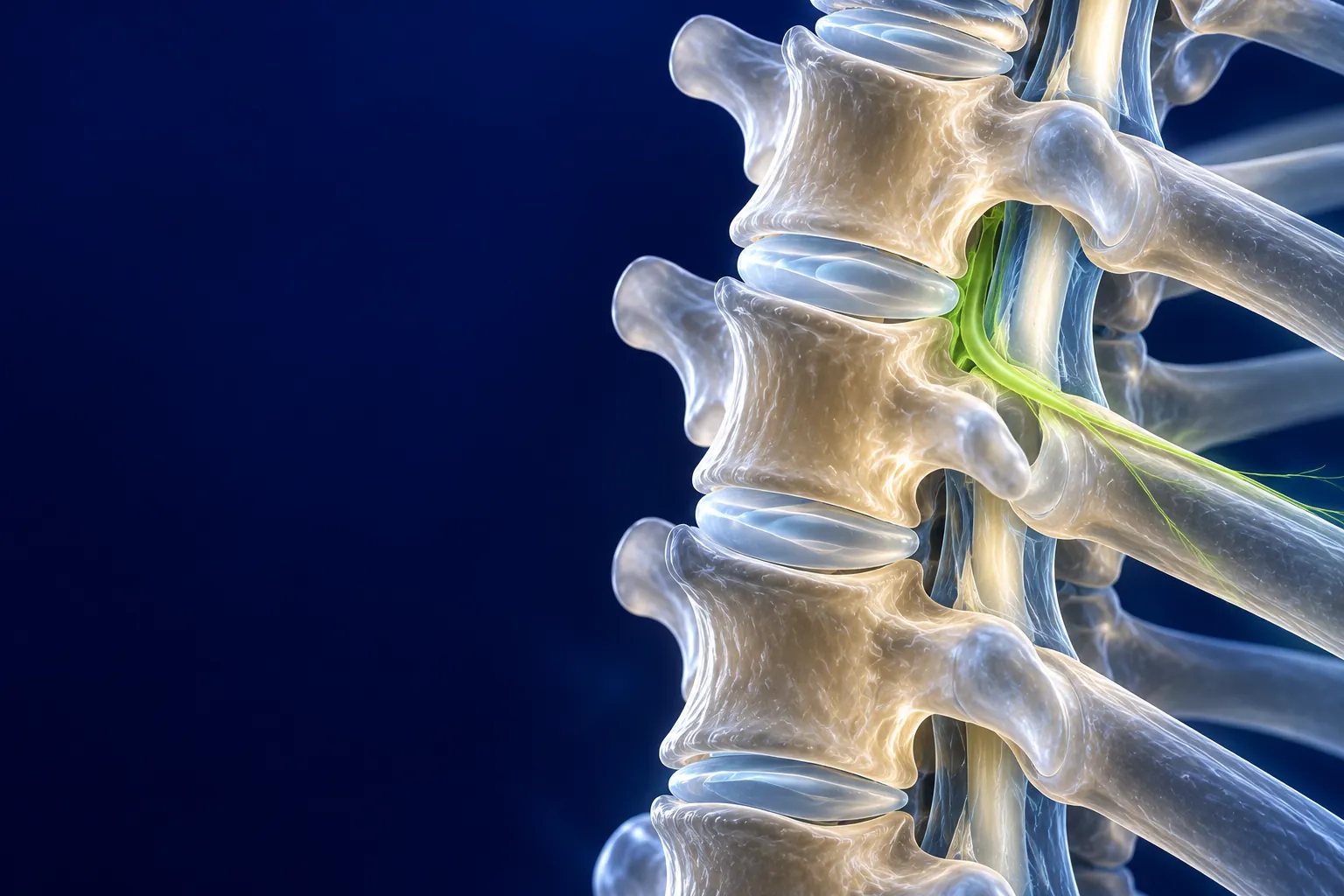
Conceptual illustration
Medically reviewed by Joshua L. Hare, DO, Founder & Medical Director
Updated October 2026
Conditions Treated
Thoracic radiculopathy, post-herpetic neuralgia (shingles pain), thoracic disc herniation, compression fracture pain, thoracic spinal stenosis
| What it treats | chronic mid and/or upper back pain[1] from a disc, a narrowed canal or an irritated nerve |
|---|---|
| Where the medicine goes | The thoracic epidural space, reached between two vertebrae |
| Imaging | Live X-ray with contrast dye; the 2025 trial authors write that it is strongly recommended to perform these injections under fluoroscopic guidance[1] |
| Visit length | 15 to 30 minutes |
| Going home | With a driver |
| In a two-year trial | Significant improvement was seen in 71% in Group I and 80% in Group II at the end of 2 years with all participants[2] (Group I: local anesthetic alone; Group II: steroid added) |
Talk with our team
Request a callback
The team calls you back within one business day, Monday to Thursday.
Insurance we acceptThe Thoracic Spine and Mid-Back Pain
The thoracic spine is the middle section of your back, between the neck and the low back. The thoracic region contains 12 vertebrae, designated T1 to T12.[3] Each one also provides articulation sites for the ribs.[3] The orientation of the ribs and the morphology of the spinous processes substantially limit flexion and extension within the thoracic spine.[3] Intervertebral disc height in the thoracic region is, on average, the smallest among the vertebral regions.[3]
One trial report cites the prevalence of thoracic pain in approximately 13% of the general population compared to 32% of the population with neck pain and 43% of the population with low back pain during the past year.[2] When it does happen, the degree of disability resulting from thoracic pain disorders seems to be similar to other painful conditions.[2] Mid and upper back pain can be severely debilitating for many individuals.[1]
Pain can start in the thoracic discs or the facet joints, and the 2014 trial report names both as pain generators.[2] An epidural injection is aimed at pain from the discs and nerves. Pain from the facet joints is treated with different procedures, a diagnostic medial branch block and, when that confirms the source, thoracic radiofrequency ablation.
The treatment explained
How a Thoracic Epidural Steroid Injection Works
The injection places medicine in the epidural space, the layer around the protective covering of the spinal cord. In the thoracic spine the bony arch of each vertebra forms the vertebral (spinal) canal, which contains the spinal cord.[3] Intervertebral discs, in conjunction with the laminae, pedicles, and articular processes of adjacent vertebrae, form spaces through which spinal nerves exit,[3] and medicine in the epidural space can reach the nerves at those openings.
Thoracic epidural injections are one of the commonly performed procedures in managing thoracic pain.[2] The medicine is a local anesthetic, usually combined with a steroid. It is hypothesized that both local anesthetics and steroids offer durable relief through various pathways,[1] including:
- the suppression of ectopic nerve discharges,[1] so an irritated nerve stops misfiring
- improvement of blood flow to ischemic nerve roots[1]
- breakdown of iatrogenic and inflammatory adhesions[1]
- removal of pro-inflammatory cytokines,[1] the chemical signals of inflammation
- the reversal of both peripheral and central sensitization,[1] which turns down an overactive pain system
Candidates
Who Gets a Thoracic Epidural Injection
A 2025 randomized trial of this injection enrolled adults described as having suffered from chronic mid and upper back pain for >6 months, and having not responded to conservative management, including medication, physical therapy, and exercise programs.[1] The trial treated chronic mid- and upper-back pain due to conditions such as disc herniation, spinal stenosis, radiculitis, or discogenic pain.[1]
The patients also had no facet joint pain confirmed through diagnostic blocks,[1] so the trial results apply to pain from the discs and nerves.
Nerve pain that wraps around the chest from the spine is a common reason for the injection. An earlier safety study treated patients with thoracic radicular pain, caused by either herniated nucleus pulposus or thoracic spondylosis as confirmed by magnetic resonance imaging,[4] in other words a disc herniation or arthritis of the spine.
Treatment day
The Day of the Thoracic Injection
- Arrange a driver before the appointment, because you will not drive yourself home.
- You are positioned prone and monitored,[1] face down on the table, as every patient was in the 2025 trial.
- The doctor works under live X-ray, because an interlaminar epidural injection in the thoracic region poses additional challenges due to the proximity of the lungs, ribs, and the angled orientation of the spinous processes.[1]
- When your pain is on one side, a midline approach may be impractical,[1] so the needle may enter slightly to that side of the midline.
- The needle position is confirmed before any medicine goes in. The 2025 trial did this by employing the loss of resistance technique and confirming the epidural space placement with 5 mL of nonionic contrast,[1] a dye that shows on X-ray.
- The local anesthetic and steroid are injected. You may feel pressure during needle placement, and the procedure takes 15 to 30 minutes.
Clinical evidence
The Evidence From Two Thoracic Epidural Trials
Two randomized trials followed patients for a year or longer after thoracic epidural injections, each comparing local anesthetic alone with local anesthetic plus steroid. Success in the 2014 trial meant a decrease of greater than 50% NRS scores and ODI scores,[2] more than half the pain and disability gone, and the 2025 trial set the bar at a reduction by >50% in both numeric rating scale and revised Oswestry Disability Index scores.[1]
- 2014 trial, followed for two years. One hundred and ten patients were randomly assigned into 2 groups with 55 patients in each group receiving either local anesthetic alone (Group I) or local anesthetic with steroids (Group II).[2] Significant improvement was seen in 71% in Group I and 80% in Group II at the end of 2 years with all participants,[2] and improvement was seen in 80% and 86% when only successful patients were considered.[2]
- 2025 trial, followed for one year. One hundred patients were randomly divided into 2 groups, 50 patients in each.[1] At 12 months, 86% of patients who received only local anesthetic and 90% of those treated with both steroid and local anesthetic reported significant improvements in their condition,[1] and patients receiving the combined therapy of local anesthetic and steroids had better results in VAS scores.[1]
The 2014 authors concluded that chronic thoracic pain of non-facet joint origin may be managed conservatively with thoracic interlaminar epidural injections with or without steroids.[2] Eleven years later, the 2025 trial found that this pain can be managed conservatively using thoracic interlaminar epidural injections, either with or without steroids.[1]
Afterward
The First Weeks After a Thoracic Injection
Relief usually begins within 2 to 7 days, as the steroid takes effect, and typically lasts from several weeks to several months.
To enhance the effectiveness of the intervention, some patients may require repeated procedures.[1] In the 2025 trial, those who showed only a partial response initially experienced >50% pain reduction after the second procedure.[1] In the 2014 trial, patients had 5 to 6 procedures per 2 years with total average relief of 80 weeks in Group I and 78 weeks in Group II in the successful patient category.[2]
Call us if you develop a fever, a severe headache that gets worse when you are upright, or new weakness or numbness in your legs after the injection.
Safety
Risks of a Thoracic Epidural Steroid Injection
A prospective study that included over 10,000 procedures[5] under fluoroscopy found that major complications are rare and minor side effects are common.[5] In that series a dural puncture, a nick in the sac of fluid around the spinal cord, was recorded at 1% in the cervical region, 1.3% in the thoracic region,[5] and the rate of needle entry into a blood vessel was 0.5% for lumbar, 3.1% for caudal, 4% for thoracic, and 4.1% for cervical epidurals.[5]
A study of thoracic injections alone reviewed 21 patients who received 39 injections.[4] Adverse effects did occur with a rate of 20.5%,[4] made up of three with increased pain at injection site (7.7%), two with facial flushing (5.1%), one transient nonpositional headache (2.6%), one episode of insomnia the night of the injection (2.6%), and one episode of fever the night of the procedure (2.6%).[4] No major complication arose.[4] All adverse effects resolved without morbidity.[4]
Reported complications and side effects include pain at the injection site, facial flushing, headache, insomnia, fever on the night of the procedure, accidental intravascular entry, significant bleeding, local hematoma, bruising, vasovagal reactions, transient nerve root irritation, and transient spinal cord irritation,[1] according to the 2025 trial's review of earlier thoracic studies. In the same review, vasovagal reactions tend to occur more frequently with transforaminal injections, whereas dural punctures are more common with interlaminar approaches.[1]
Severe complications were reported, including paralysis and death, resulting from cervical and thoracic transforaminal epidural injections where only local anesthetics were used,[1] and patients with a history of previous surgeries are considered to be at an even higher risk of experiencing these severe complications.[1] Steroids come in particulate and non-particulate forms, and particulate steroids pose a higher risk of complications than non-particulate ones.[1] The accidental intravascular injection of particulate steroids can increase the likelihood of ischemic events.[1]
In the 2025 trial, no serious injection-related complications or side effects were reported among the participating patients.[1] Mention blood-thinning medication, earlier operations on your spine, and any past reaction to contrast or anesthetic when the injection is being scheduled.
References
Clinical sources for this page.
- Aliyev D, Bayram D, Aşik İ. Comparison of the effectiveness of thoracic epidural steroid and local anesthetic injections: a randomized controlled trial. Medicine (Baltimore). 2025;104(46):e45994. Back to first citation ↑
- Manchikanti L, Cash KA, McManus CD, et al. Thoracic interlaminar epidural injections in managing chronic thoracic pain: a randomized, double-blind, controlled trial with a 2-year follow-up. Pain Physician. 2014;17(3):E327–E338. Back to first citation ↑
- Waxenbaum JA, Reddy V, Margetis K. Anatomy, Back, Thoracic Vertebrae. StatPearls [Internet]. StatPearls Publishing; updated January 31, 2026. Back to first citation ↑
- Botwin KP, Baskin M, Rao S. Adverse effects of fluoroscopically guided interlaminar thoracic epidural steroid injections. American Journal of Physical Medicine & Rehabilitation. 2006;85(1):14–23. Back to first citation ↑
- Manchikanti L, Malla Y, Wargo BW, et al. A prospective evaluation of complications of 10,000 fluoroscopically directed epidural injections. Pain Physician. 2012;15(2):131–140. Back to first citation ↑
Five clinics
Book a visit
Our fellowship-trained physicians are accepting new patients at five clinics: Dalton, Ringgold, Cleveland, Farragut and Oak Ridge.