

Trigger Points & Soft Tissue
Piriformis Injection
A piriformis injection places local anesthetic, and sometimes a corticosteroid, into the piriformis muscle deep in the buttock. Tightness or spasm in that muscle can irritate the sciatic nerve running beside it and produce pain down the leg.
Conceptual illustration
Medically reviewed by Joshua L. Hare, DO, Founder & Medical Director
Updated August 2026
Conditions Treated
Piriformis syndrome, deep buttock pain, and sciatic-type leg pain arising from the piriformis muscle rather than the spine.
The key facts
Piriformis Injection at a Glance
| Type of procedure | Outpatient, image-guided (ultrasound or fluoroscopy) |
|---|---|
| Anesthesia | Local anesthetic at the skin |
| Time in the procedure room | About 20–30 minutes, lying face down |
| Going home | Same day; arrange a driver, since the leg can feel temporarily heavy or numb afterward |
| What goes in | Local anesthetic, often with a corticosteroid; botulinum toxin is a further option[1] in selected cases |
| Relief timing | Numbing effect the same day; any steroid effect builds over several days |
| Dual purpose | Treats the muscle and, at the same time, tests whether it is truly the pain source |
Talk with our team
Request a callback
The team calls you back within one business day, Monday to Thursday.
Insurance we acceptThe Piriformis and the Sciatic Nerve
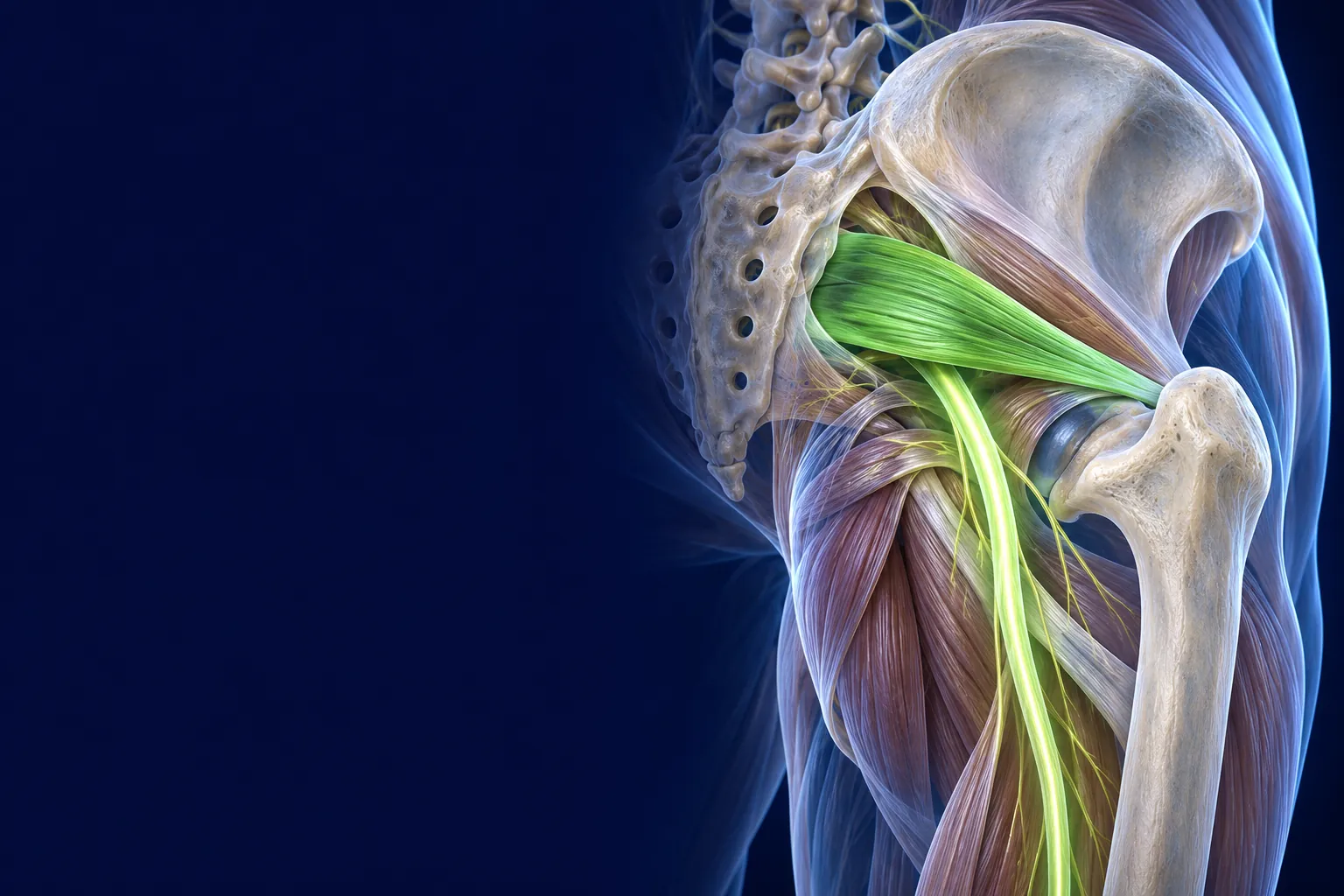
The piriformis is a flat, band-shaped muscle running from the sacrum to the top of the thigh bone, buried deep beneath the larger gluteal muscles. Its importance comes from its neighbor: the sciatic nerve passes immediately alongside it, and in some people the anatomy is closer still — the reference literature describes a configuration in which the sciatic nerve or its branches pass directly through the piriformis muscle.[1] When the muscle is irritated or inflamed, it affects the sciatic nerve, producing sciatica-like pain[2] that runs into the buttock and down the leg.
How Piriformis Syndrome Is Diagnosed
Piriformis syndrome is easy to miss and easy to over-call, and the published estimates are wide: it may be responsible for 0.3% to 6% of all cases of low back pain and/or sciatica.[2] There is no blood test or scan that proves it; the diagnosis is primarily clinical, and one of exclusion[2] — the spine, hip and sacroiliac joint have to be examined and ruled out first.
A few clues point toward the muscle rather than the spine. Symptoms typically worsen with prolonged sitting.[2] Pressing on the muscle reproduces deep buttock tenderness. And in the exam room, the physician can perform the FAIR maneuver — flexion, adduction and internal rotation of the hip — to try to reproduce the symptoms[2] by putting the piriformis on stretch.
Conservative Care Comes First
An injection is rarely the opening move. Initial treatment for piriformis syndrome is conservative: short-term rest of no more than 48 hours, muscle relaxants, NSAIDs, and physical therapy built around stretching the muscle.[2] The injection enters the picture for persistent sciatic-type pain of deep gluteal origin after spinal, hip and sacroiliac causes have been excluded, when conservative therapy has failed, or when the diagnosis itself needs clarifying.[1]
Treatment day
The Day of the Procedure
- Positioning. You lie face down while the skin over the buttock is cleaned and numbed.
- Imaging. Under fluoroscopy, the view is centered over the lower sacroiliac joint with the greater trochanter in view,[1] framing the muscle between its two anchor points; ultrasound is the alternative, watching the layers directly.
- Needle placement. The needle passes through the gluteal muscles into the piriformis, with image guidance protecting the sciatic nerve beside it.
- Confirming spread. The physician confirms appropriate spread of the injectate[1] before the full dose goes in.
- The injection and home. The medication is delivered, and after a short observation you leave with your driver.
A Test and a Treatment in the Same Needle
As treatment, the medication works to reduce inflammation and ease muscle spasm.[1] As a test, it confirms the localization of the pain generator:[1] if numbing this one muscle switches the pain off, we know the muscle is the source. A clear response supports continuing to treat the muscle. No response sends the work-up back to the spine, hip and sacroiliac joint, with the piriformis ruled out.
Safety
Risks and Side Effects
Complications are uncommon. The reference literature lists bleeding, infection, post-injection soreness, transient worsening of pain, headache, allergic reactions to the injectate, and the possibility that the procedure simply does not relieve the pain.[1] When a corticosteroid is used, its own short-lived effects apply — a temporary rise in blood sugar and facial flushing[1] among them, worth knowing about if you have diabetes. Expect the possibility of a heavy or numb leg for a few hours where anesthetic reaches the sciatic nerve; that is anatomy, not a complication, and it is the reason for the driver.
Your questions
Common Questions
- How is this different from sciatica caused by a disc?
- The leg pain can feel identical, which is why the two are so often confused. A herniated disc irritates the nerve root at the spine; piriformis syndrome irritates the sciatic nerve out in the buttock, so spine imaging often looks unremarkable. The exam findings above, and the injection itself, are how the two get told apart.
- Why does a muscle injection need X-ray or ultrasound?
- Because the target is deep under the gluteal muscles with the sciatic nerve pressed against it — and in some people running through it. Image guidance puts the medication in the muscle and keeps the needle clear of the nerve.
- Botulinum toxin — in a buttock muscle?
- It appears in the reference literature as an option for this injection, used to quiet a muscle that keeps returning to spasm. Where your physician suggests it, the reasoning — including that such use may sit outside FDA-approved labeling — is laid out plainly first, the same standard we apply to botulinum toxin for pain anywhere in the practice.
- What does it mean if the injection does not help?
- It means the piriformis probably was not the answer, and that is worth knowing. The work-up moves back to the other causes of buttock and leg pain — the lumbar spine, the hip and the SI joint.
Five clinics
Book a visit
Accepting new patients at five clinics: Dalton, Ringgold, Cleveland, Farragut and Oak Ridge.