

Nerve Blocks
Genicular Nerve Radiofrequency Ablation
Genicular nerve radiofrequency ablation (RFA) uses thermal energy to disrupt the genicular nerves that transmit pain from the knee joint, providing prolonged pain relief for patients with chronic knee osteoarthritis or post-surgical knee pain who responded positively to diagnostic genicular nerve blocks.
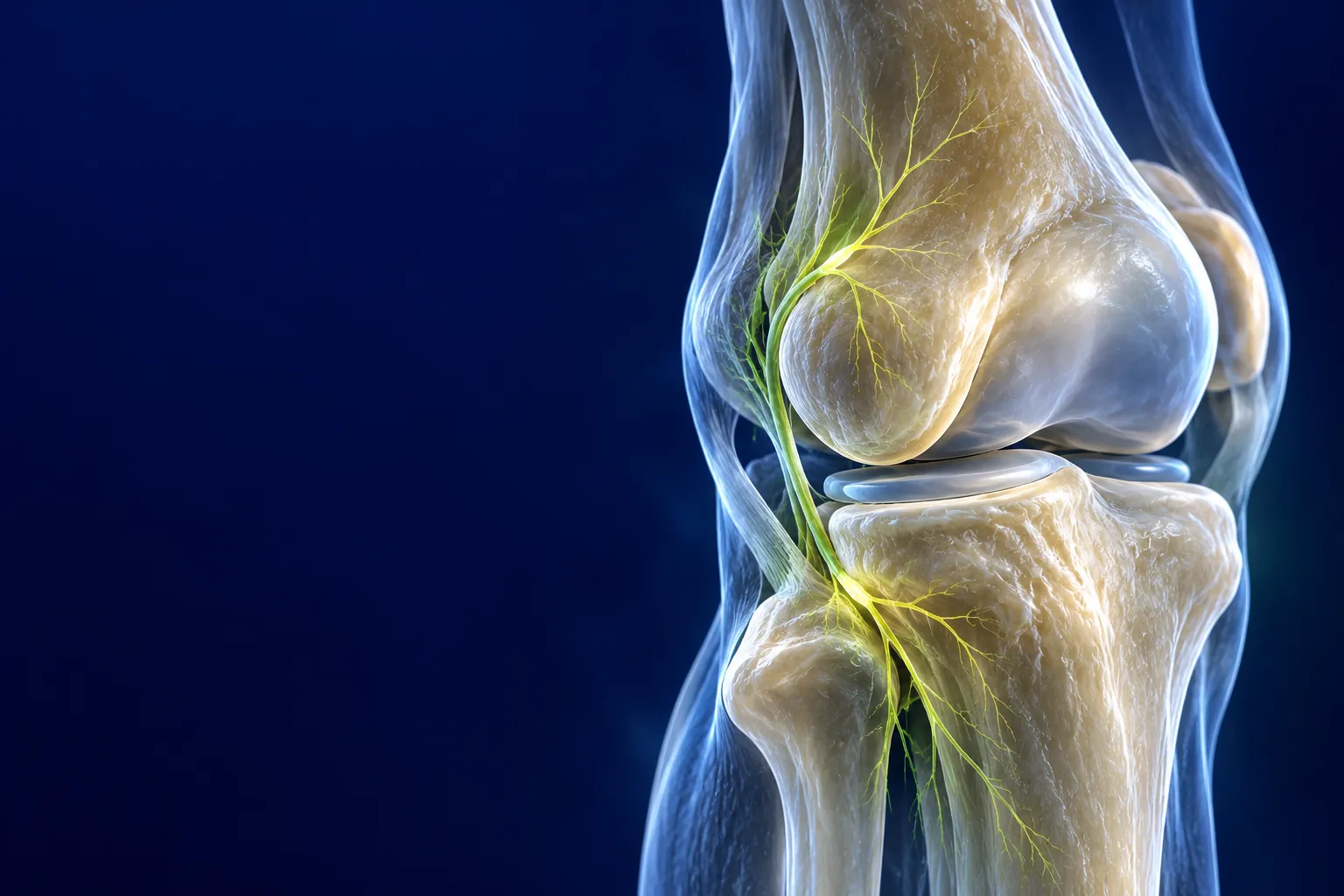
Conceptual illustration
Medically reviewed by Joshua L. Hare, DO, Founder & Medical Director
Updated September 2026
Conditions Treated
Chronic knee osteoarthritis confirmed by diagnostic genicular nerve block, post-total knee replacement pain, patients who are not candidates for or want to delay knee replacement surgery
The key facts
Genicular Nerve RFA at a Glance
| Type of procedure | Outpatient, image-guided (fluoroscopy) |
|---|---|
| Anesthesia | Local anesthetic at the skin over each nerve target |
| Time in the procedure room | About 30–45 minutes |
| Back to normal activity | Within a few days |
| Relief typically develops | Over 2–4 weeks; a temporarily sorer knee often comes first |
| Relief typically lasts | Months — in trial follow-up, most patients kept at least half their relief at six months,[1] and a followed subset still reported relief at 18–24 months[2] |
| Repeatable | Yes — genicular branches regenerate on their own schedule, and a repeat can follow when the pain pattern returns |
Talk with our team
Request a callback
The team calls you back within one business day, Monday to Thursday.
Insurance we acceptThe Qualification Comes First
A diagnostic genicular nerve block has to show that numbing these specific branches drops your knee pain by half or more, the threshold we use to qualify you for the ablation and the same cut-off the randomized cooled radiofrequency trial used to select its patients.[1]
The treatment explained
How It Works
After successful diagnostic genicular nerve blocks,[3] radiofrequency probes are placed at the three genicular nerve targets under fluoroscopic guidance. Controlled thermal energy creates lesions that interrupt pain transmission from the knee.
The genicular nerves are sensory branches — they report pain from the joint but do not move the leg, which is why quieting them does not weaken the knee. The knee trials used cooled radiofrequency, a probe design that heats a larger volume of tissue around a temperature-controlled tip. The ablation does not change the joint itself, and arthritis care for the knee continues alongside it.
Candidates
Who It Helps — and Who It Does Not
The candidates are specific: knees with chronic osteoarthritis pain that a diagnostic block has confirmed, patients still hurting after a knee replacement, and patients who are not candidates for replacement surgery or want to put it off. In the multicenter trial, subjects had carried their knee pain for six months or longer without response to conservative care[1] before treatment. The 2019 American College of Rheumatology guideline carries a conditional recommendation for radiofrequency ablation for knee osteoarthritis[4] — a measured endorsement, and the reason patient selection through the block is not optional here.
A block that did not relieve your pain rules this procedure out; so does knee pain that is really referred from the hip or the spine, which the work-up checks first. And the ablation does not rebuild cartilage or straighten a worn joint — it turns the volume down on the pain signal.
Treatment day
The Day of the Procedure
- Check-in and positioning. You settle on your back with the knee positioned the way it was for your block; the skin is prepped, and monitoring stays on for the visit.
- Numbing. The skin over each of the three nerve targets is numbed.
- Guided placement. The radiofrequency probes are advanced to the same landmarks your block confirmed, each checked on the fluoroscope before treatment.
- Treatment. Each of the three confirmed targets is treated in turn; the full sequence runs about 30–45 minutes.
- Home the same day. You rest in the recovery area for a short stretch, then leave with your aftercare sheet.
Clinical evidence
What the Evidence Shows
In the double-blind randomized trial, block-selected patients had less knee pain at 4 and 12 weeks than the sham group,[3] with 59% still holding at least half their relief at 12 weeks. In the larger multicenter comparison, at six months 74.1% of ablation patients had at least half their pain relieved, against 16.2% with a steroid injection into the joint.[1] And at the longest follow-up, a followed subset of those patients still reported relief and improved function at 18 and 24 months.[2] The diagnostic block identifies the patients whose knee pain is carried by these nerves, which is how we make sure the ablation is aimed at the right target before anyone commits.
Afterward
Recovery, Week by Week
| First 48 hours | The knee often aches more at first — ice helps, and the discharge sheet covers medication timing. |
|---|---|
| Weeks 1–2 | A sorer knee through these two weeks is the expected pattern while the treated branches react. |
| Weeks 2–4 | This is when relief typically shows up; day-to-day use of the knee normalizes earlier for most people. |
| The months after | Genicular branches regrow over time. If the pain pattern returns after a solid stretch of relief, ask about a repeat at your follow-up. |
Safety
Risks and Side Effects
The safety record in the trials: in the randomized trial, no patient reported a post-procedure adverse event during follow-up,[3] and the multicenter comparison recorded no procedure-related serious adverse events.[1] The expected cost is the temporary soreness described above; numbness of a patch of skin near a treated site can occur, and the rare risks of any needle procedure — bleeding, infection — get covered at scheduling, blood thinners included.
Your questions
Common Questions
- How long will the relief last?
- Trial follow-up found most patients holding at least half their relief at six months, and a smaller followed group still reporting relief at 18 to 24 months. The treated branches do regrow eventually; when the pain returns, the procedure can be repeated.
- Will my knee work better, or just hurt less?
- The trials tracked function alongside pain — standing, walking, stairs — and treated patients improved on those functional scores as well; much of daily limitation is the pain itself.
- Is the heat damaging my knee?
- The lesions are made in sensory nerve branches outside the joint, not in cartilage, bone or the muscles that move the leg. The arthritis itself is unchanged — this procedure manages what the joint can make you feel, and the rest of your knee care continues in parallel.
- Could I have the ablation without the test block?
- Not at IPC. The block is the evidence the ablation is aimed at the right nerves, it is how the pivotal trial selected its own patients, and skipping it risks a procedure with no target. If your block was negative, that result saved you one.
References
Clinical sources for this page.
- Davis T, Loudermilk E, DePalma M, et al. Prospective, multicenter, randomized, crossover clinical trial comparing the safety and effectiveness of cooled radiofrequency ablation with corticosteroid injection in the management of knee pain from osteoarthritis. Regional Anesthesia and Pain Medicine. 2018;43(1):84–91. PMC full text Back to first citation ↑
- Hunter C, Davis T, Loudermilk E, Kapural L, DePalma M. Cooled radiofrequency ablation treatment of the genicular nerves in the treatment of osteoarthritic knee pain: 18- and 24-month results. Pain Practice. 2020;20(3):238–246. Back to first citation ↑
- Choi WJ, Hwang SJ, Song JG, et al. Radiofrequency treatment relieves chronic knee osteoarthritis pain: a double-blind randomized controlled trial. Pain. 2011;152(3):481–487. Back to first citation ↑
- Kolasinski SL, Neogi T, Hochberg MC, et al. 2019 American College of Rheumatology/Arthritis Foundation Guideline for the Management of Osteoarthritis of the Hand, Hip, and Knee. Arthritis & Rheumatology. 2020;72(2). Back to first citation ↑
Five clinics
Book a visit
Our fellowship-trained physicians are accepting new patients at five clinics: Dalton, Ringgold, Cleveland, Farragut and Oak Ridge.