

Patient guide
Nerve block vs. radiofrequency ablation
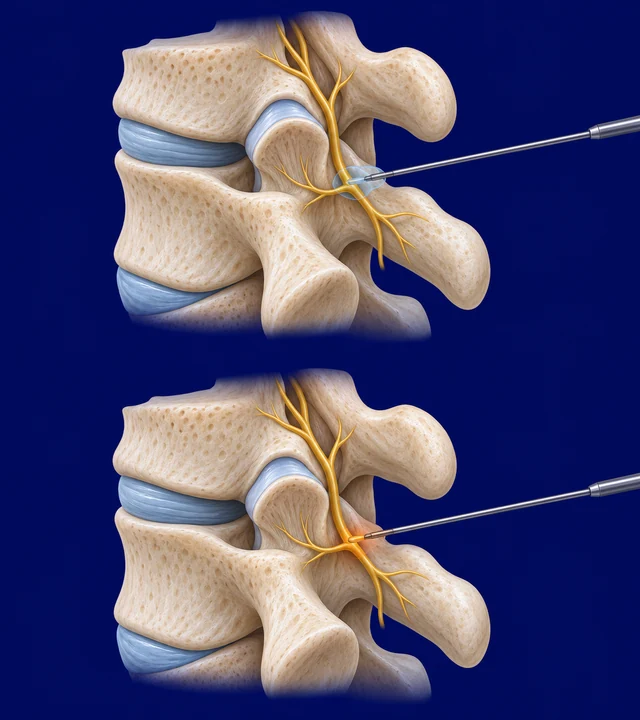
A nerve block numbs a pain-carrying nerve for a short time. Radiofrequency ablation uses heat so the same nerve stops sending pain signals for months.
- Image-guided
- Outpatient
- No incision
Conceptual illustration
Medically reviewed by Joshua L. Hare, DO, Founder & Medical Director
Updated October 2026
The short answer
A nerve block is an injection of numbing medicine beside a nerve. Nerve blocks use a local anesthetic to temporarily interrupt the relay of pain messages between specific areas of the body and the brain.[1] Radiofrequency ablation (RFA) uses a radio wave to heat up and destroy a small area of nerve tissue to stop pain signals to the brain,[1] and its relief lasts far longer. For spine and joint pain, a block often comes first as a test: when it eases your pain, that nerve becomes the target for RFA.
The test and the short-term option
What a nerve block is
A nerve block is an injection placed beside a nerve that carries pain. The medicine is a local anesthetic, the same kind of numbing medicine a dentist uses. Some blocks add a steroid.
A block does one of two jobs. A diagnostic block answers a question: does this nerve carry your pain? The test before RFA is a diagnostic block, to confirm the source and level of your pain.[3] A therapeutic block is given for relief in its own right, often for a nerve that RFA is not used on.
We perform these blocks across our clinics. Each one targets a different nerve:
| Block | Where it works |
|---|---|
| Medial branch block | The small nerves to the facet joints of the spine |
| Selective nerve root block | One spinal nerve root as it leaves the spine |
| Genicular nerve block | The nerves around the knee joint |
| Occipital nerve block | The nerves at the back of the head |
| Intercostal nerve block | The nerves running between the ribs |
| Peripheral nerve block | A named nerve in the shoulder, arm, leg or trunk |
| Stellate ganglion block | Sympathetic nerves in the front of the neck |
| Lumbar sympathetic block | Sympathetic nerves beside the lower spine |
| Celiac plexus block | The nerve bundle serving the upper abdomen |
| Superior hypogastric plexus block | The nerve bundle serving the pelvis |
| Ganglion impar block | The nerve bundle in front of the tailbone |
The longer-lasting step
What radiofrequency ablation is
Radiofrequency ablation, also called radiofrequency neurotomy, uses radio waves to create a current that heats a small area of nerve tissue.[3] The heated spot on the nerve can no longer pass pain signals along.
A thin needle reaches the nerve under a special kind of real-time continuous X-ray called fluoroscopy.[3] Before any heat is applied, a small electrode checks the position: your doctor will ask if you feel a tingling sensation (or discomfort or a muscle twitch).[3] Then a local anesthetic is injected through the needle to numb the target area.[3] The 2020 lumbar guideline notes that the temperature generated at the tip of the cannula is usually between 80°C and 90°C and heating is generally performed for 1 to 3 min.[2] More than one nerve can be treated during the procedure (if needed).[3]
RFA is often used to manage pain originating from joints (such as your knee)[3] and from the spine. We perform it for the lower back, neck, mid back, sacroiliac joint and knee.
At a glance
Nerve block and ablation side by side
| Question | Nerve block | Radiofrequency ablation |
|---|---|---|
| What it does | Numbs a nerve so it stops relaying pain for a while | Heats a small area of the nerve so it stops relaying pain for months |
| What is used | A local anesthetic, sometimes with a steroid | A radiofrequency current is sent through the needle[3] |
| Main job | Testing which nerve carries the pain, or short-term relief | Longer relief once the nerve has been confirmed |
| How long relief lasts | A diagnostic block lasts only as long as the numbing medicine | Often six months to 12 months,[3] sometimes longer |
| When relief starts | As soon as the numbing medicine takes hold | It can be immediate in some people, occur within 10 days in other people or may take up to three weeks in others[3] |
| Time in the procedure room | Most of our procedures take 15 to 45 minutes | Anywhere from 15 minutes to two hours,[3] depending on how many nerves are treated |
| Sedation | Usually none for a diagnostic block, so the result is clear | Medications can be given during the procedure to relax you but this is optional[3] |
| Going home | The same day | The same day, with a driver |
| Common after-effects | Soreness where the needle went in, and numbness while the medicine lasts | Soreness or burning at the site that may last for a week or two after the procedure[3] |
| What comes next | Good relief points toward RFA | RFA can be repeated if the pain comes back |
Talk with our team
Request a callback
The team calls you back within one business day, Monday to Thursday.
Insurance we acceptHow candidates are chosen
Why a nerve block usually comes first
RFA treats a nerve that a block has already shown to carry the pain. The first sign Cleveland Clinic lists that RFA may suit you is pain relief following a nerve block injection,[3] because it tells your provider that that particular nerve is the source of your pain and is an appropriate target for RFA.[3]
The 2020 multispecialty guideline on lumbar facet pain says that if a block relieves pain, then a treatment capable of physically interrupting conduction along the same nerve(s) should provide comparable relief, but last longer.[2] For the spine, the medial branch block is the test we use before RFA.
You stay awake for the test on purpose. The same guideline advises that sedation should not be routinely administered for diagnostic or prognostic facet injections,[2] because sedatives carry the increased risk of a false-positive block.[2] Afterward you keep a short pain diary and try the movements that usually hurt; our medial branch block page explains how.
- Evaluation. Your history, an exam and a look at your imaging.
- Test block. Numbing medicine on the nerves we suspect.
- Pain diary. You record how much the pain eased in the hours after.
- Ablation. If the block relieved your pain, RFA treats the same nerves.
- Follow-up. We check your progress, and repeat RFA if the pain returns.
After you go home
Recovery after each procedure
You can get up and move around soon after a nerve block. The area can feel numb or heavy while the medicine lasts. If a steroid was used, the guideline on steroid injections notes possible effects that include an increase in blood glucose,[4] so people with diabetes should watch their readings for a few days.
After RFA you will go home shortly after your procedure.[3]
| First 24 hours | Don’t drive or do anything strenuous for 24 hours after the procedure.[3] An ice pack, off and on for 20 minutes,[3] can ease soreness. |
|---|---|
| Days 1 to 2 | After a day or two, you can return to your normal activities,[3] including bathing or showering. |
| The first week or two | You may still feel soreness, pain or muscle spasms at the treatment site for a few days;[3] burning at the site can last a little longer. |
| The weeks after | Relief builds; for some people it is immediate, for others it takes up to three weeks. You will have a follow-up visit to check your progress. |
Safety
Side effects and risks
Both procedures are done through a needle, so the common effects are local: soreness, bruising and temporary numbness where the needle went in. Bleeding is uncommon after medial branch blocks (MBBs): a study that reported on complications from 3162 MBBs found superficial bleeding or hematomas in 0.1%–0.4% of the patients.[2]
The risk of complications from RFA is very low.[3] The effects to know about:
- You may feel some temporary numbness where the needle entered your skin.[3]
- A burning or sensitive feeling over the treated area, called neuritis. One study of 164 patients found no difference in the incidence of postprocedure neuritis[2] with or without a steroid after the procedure; in both groups it affected about 6 to 7 in 100.
- On occasion, permanent nerve damage or pain can occur.[3]
- In some people, their original pain may get worse.[3]
- Other complications, including infection and bleeding at the needle insertion site, are uncommon.[3]
Tell your doctor if you have a pacemaker, defibrillator, or a deep brain or spinal cord stimulator; the guideline lists impact on implanted electrical devices[2] among the risks to plan around. Tell us too if you take a blood thinner. Do not stop it on your own; the guideline says cases that might warrant discontinuation should be discussed with relevant healthcare providers.[2] You may not be a candidate for radiofrequency ablation if you[3] are pregnant, have an infection or have a bleeding problem.
Call us if the needle site becomes very painful or shows redness or swelling,[3] or if you have increased weakness or numbness in an arm or leg.[3]
Common questions
Is radiofrequency ablation considered surgery?
No incision is made. Cleveland Clinic says it is considered a minimally invasive procedure,[3] done through a needle with you awake or lightly relaxed, and you go home the same day.
How long does a nerve block last?
A diagnostic block lasts only as long as its numbing medicine, which has a relatively short duration of action.[2] That window is long enough to test the movements that usually hurt. Blocks that include a steroid are meant to give longer relief.
How long does radiofrequency ablation last?
Pain relief can last from six months to 12 months.[3] The treated nerve can regrow,[3] and if pain comes back, RFA can be done again.
Can radiofrequency ablation be repeated?
Yes. In a 2012 review of repeat RFA, the unweighted average success rate of repeat RFA was approximately 80% in patients who experienced a good outcome from the first RFA procedure.[2] The average duration of pain relief was also similar following repeat RFA compared with the initial RFA response (10 months).[2]
Does radiofrequency ablation hurt?
The skin and the target area are numbed first. Some people feel some pain or burning sensation at the site[3] during the procedure, and soreness for a week or two afterward.
Which one is right for me?
That depends on where the pain comes from. For spine and knee pain, the usual path is a test block first and RFA if the block works. For other nerves, a block may be the treatment itself. We work out which applies at your first visit.
References
Clinical sources for this page.
- National Institute of Neurological Disorders and Stroke. Pain. National Institutes of Health; accessed October 30, 2026. Back to first citation ↑
- Cohen SP, Bhaskar A, Bhatia A, et al. Consensus practice guidelines on interventions for lumbar facet joint pain from a multispecialty, international working group. Regional Anesthesia and Pain Medicine. 2020;45(6):424–467. Back to first citation ↑
- Cleveland Clinic. Radiofrequency Ablation (RFA). Accessed October 30, 2026. Back to first citation ↑
- Benzon HT, Elmofty D, Shankar H, et al. Use of corticosteroids for adult chronic pain interventions: sympathetic and peripheral nerve blocks, trigger point injections. Regional Anesthesia and Pain Medicine. 2026;51(6):642–659. Back to first citation ↑
Five clinics
Find out which procedure fits your pain
Start with an evaluation at any of our five clinics: Dalton, Ringgold, Cleveland, Farragut or Oak Ridge.